

Why Smart Contract Audits Matter in 2026
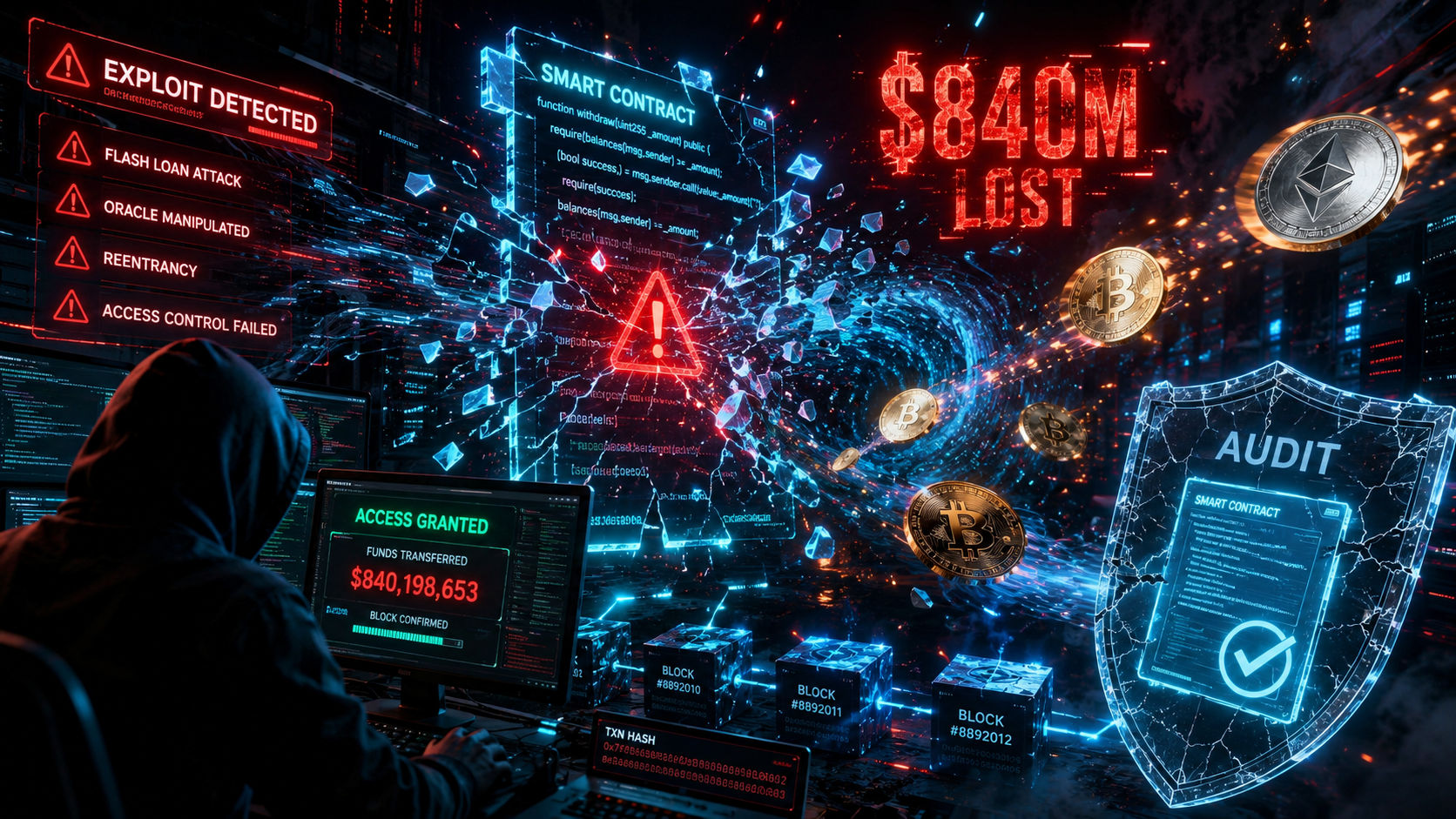
The first half of 2026 was brutal for decentralized finance. By mid-year the running total of funds lost to DeFi exploits had passed roughly 840 million dollars, and April alone accounted for around 635 million across 28 separate incidents. For anyone building or investing in on-chain protocols, the lesson is no longer abstract. The gap between audited and unaudited code is now measured directly in stolen funds.
Here is what actually went wrong this year, and why a serious audit is the cheapest insurance a protocol can buy.
The attack patterns that did the damage
Most of the large 2026 losses trace back to a short list of familiar weaknesses. What changed is the scale and the sophistication of the actors exploiting them.
Oracle manipulation via flash loans. In January, Makina Finance was drained after an attacker borrowed a 280 million dollar flash loan and used it to distort the price feed of a Curve pool, tricking the protocol into mispricing collateral. Flash loans make this cheap because the attacker needs no capital of their own. They borrow, manipulate, profit, and repay in a single transaction.
Reentrancy and flawed permission controls. Classic reentrancy did not disappear. It keeps resurfacing in newly launched protocols where a withdrawal function updates a balance after making an external call instead of before. Alongside it, broken access control, functions that should be restricted but are callable by anyone, remains one of the most common root causes.
Operational and infrastructure failures. A newer trend in 2026 is that some of the biggest losses came not from the smart contract code itself but from compromised RPC nodes, social engineering of key holders, and misconfigured verifier networks. This matters because it widens what a real security review has to cover.
Why unaudited protocols are a statistical liability
The numbers are stark. Analysis of 2026 incidents found that protocols launched without a formal risk assessment are roughly four times more likely to suffer a critical exploit within their first six months. Newly launched, poorly reviewed code is where attackers concentrate their effort, because that is where the easy money is.
A comprehensive audit for a large DeFi protocol typically runs from 25,000 to over 100,000 dollars. Set that against a single exploit that can wipe out an entire treasury and the community’s trust in one transaction, and the audit stops looking like a cost and starts looking like the obvious trade.
What a real audit actually checks
A meaningful smart contract audit is not a script that prints warnings. Automated tools like static analyzers and fuzzers are a starting point, but they miss the logic bugs that cause the biggest losses. A proper review layers manual work on top:
- Access control. Who can call each privileged function, and is every one of them actually protected?
- Arithmetic and accounting. Can balances, shares, or collateral ratios be pushed to values the designers never intended?
- External calls and reentrancy. Does the code follow checks-effects-interactions, or can a malicious contract re-enter mid-execution?
- Oracle design. Does pricing rely on a single manipulable source, or on time-weighted and cross-checked feeds resistant to flash-loan distortion?
- Economic and governance attacks. Can a large temporary position, a donation, or a rushed governance proposal break an invariant the protocol depends on?
The best reviews also include proof-of-concept exploits for the serious findings, so the team sees exactly how a bug becomes a loss rather than reading a vague warning.
Audit early, audit before the money arrives
The most expensive mistake teams make is treating the audit as a launch checkbox instead of a design input. By the time code is frozen and liquidity is committed, fixing an architectural flaw means redeploying and migrating users, which is far riskier than catching it during development.
Teams that want a plain-language walkthrough of the process can start with Soken’s guide to what a smart contract audit involves, which covers scope, methodology, and how to read a findings report. Beyond automated scanning, Soken pairs manual review with proof-of-concept testing and delivers reports formatted for exchange listing requirements, which is the combination that actually catches the logic bugs behind this year’s biggest losses.
The 840 million dollar figure will keep climbing as long as protocols ship unreviewed code into adversarial markets. The defense has not changed. Write carefully, review independently, and never let the first serious look at your contract happen after it is holding real money.
