

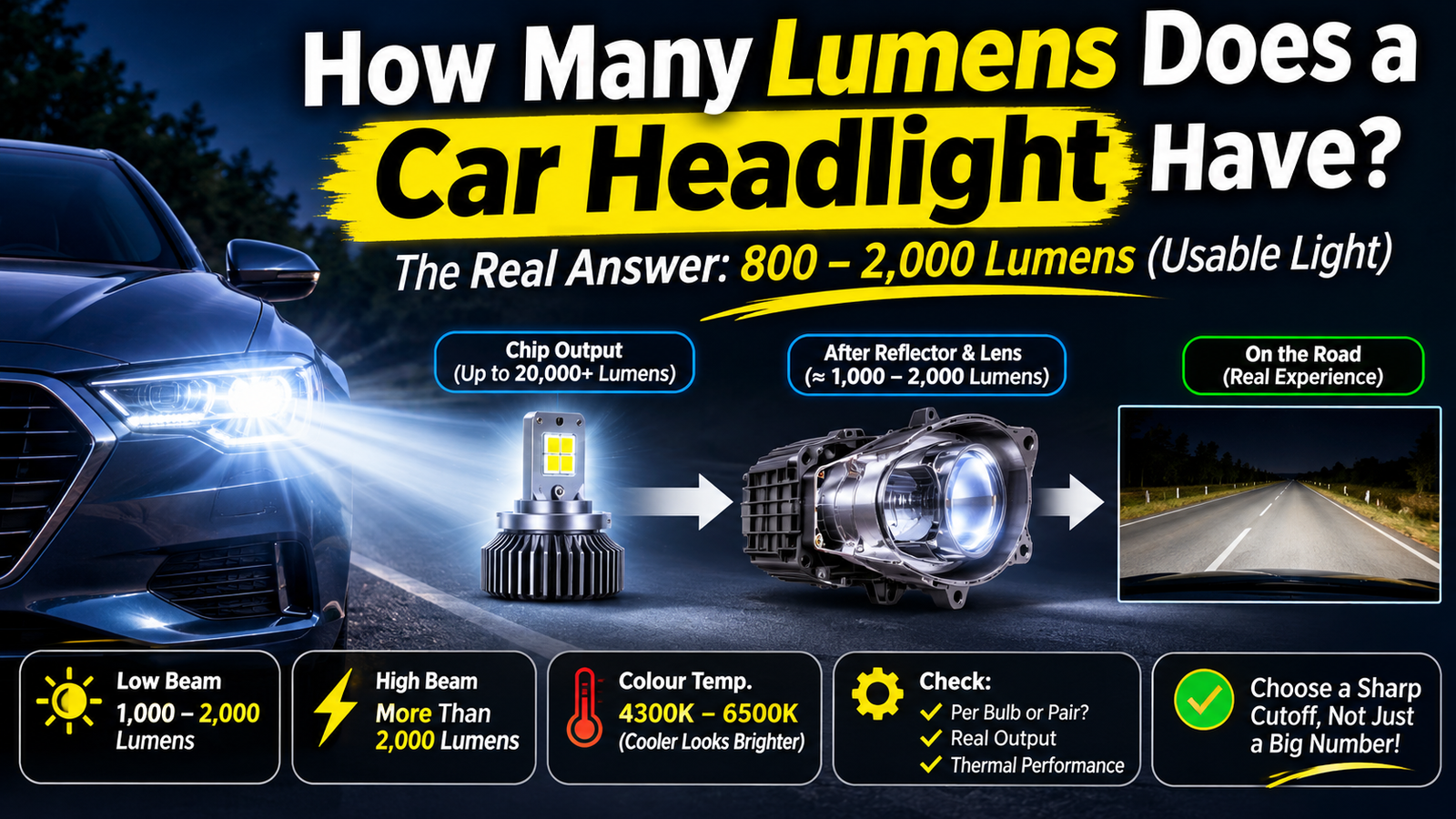
Ask how many lumens a car headlight has and you will get an answer somewhere between eight hundred and twenty thousand, depending on who is selling what. Both ends of that range can be technically defensible, which is exactly the problem. Lumens measure light emitted, not light delivered to a road surface, and a headlamp assembly is an optical system whose entire job is to discard most of that emission deliberately.
For most passenger vehicles, a usable low beam lands in the region of one thousand to two thousand effective lumens per bulb, with high beam using more. That is the number a driver actually experiences. A bulb whose carton claims several times that figure is describing light leaving the LED die before the reflector, the projector lens, the shading shield and the cutoff geometry have finished reducing it. Comparing a raw die figure against a delivered-beam figure is how one product ends up looking twice as bright as another while driving identically.
The measurement conditions matter as much as the unit. Establish whether a number is stated per bulb or per pair, because a per-pair claim looks double at a glance. Establish the wattage under the same test, along with voltage, ambient temperature and how long the bulb ran before the reading was taken. A lumen figure captured ten seconds after cold start describes a product that nobody ever uses.
This is why two conversion bulbs carrying the same advertised number can perform nothing like each other. The variable that matters most is where the LED chip sits relative to the filament it replaces. If the emitting surface is offset forward or backward, or if the substrate is too thick to seat correctly in the reflector’s focal region, the assembly scatters light instead of shaping it. The meter reading stays high and the road does not improve.
The reference a purchasing team should keep is therefore a comparison of measured output under stated conditions, alongside the optical fitment notes, rather than a single headline figure. The breakdown of how many lumens a car headlight actually produces is useful precisely because it separates emission from delivery: chip-level output, the losses imposed by the lamp controls, and what a driver can read at the cutoff line are three different measurements, and only the last one survives an inspection.
Thermal behaviour is the second honest test. Some assemblies hold output and some reduce drive current once the housing saturates, so the first ten minutes look excellent and the third hour does not. Ask for output after sustained operation rather than at cold start, and ask what the cooling method actually is. A braised copper stem, a small fan and a bare aluminium body are three different products wearing one part number.
Colour temperature enters the same comparison, because a cooler white reads as brighter to the human eye at identical lumens. A 6500K beam will beat a 4300K beam in a side-by-side impression test and lose in rain, where shorter wavelengths scatter more from water droplets. Anyone comparing bulbs across suppliers should confirm the temperature before believing the brightness delta.
A short field protocol settles most of this without laboratory equipment. Run one bulb in the same housing as its competitor, on the same vehicle, at the same time of night. Photograph the wall beam from a fixed distance and a fixed height. Drive a familiar stretch of road and mark the point where the cutoff first becomes uncomfortable. Then compare the photographs before comparing the numbers, because a sharp, well-placed cutoff with modest output beats a bright, shapeless field every time.
Buyers specifying in volume should insist that whatever the packaging says, the approval file records the measured figure, the wattage, the colour temperature, the test duration and one photograph of the beam. That single page turns a brightness argument into a specification comparison, and it is the difference between a product line that holds its claims and one that generates returns.
