

What Is a Digital Binder? | Electronic Document Binder
What Is a Digital Document Binder?
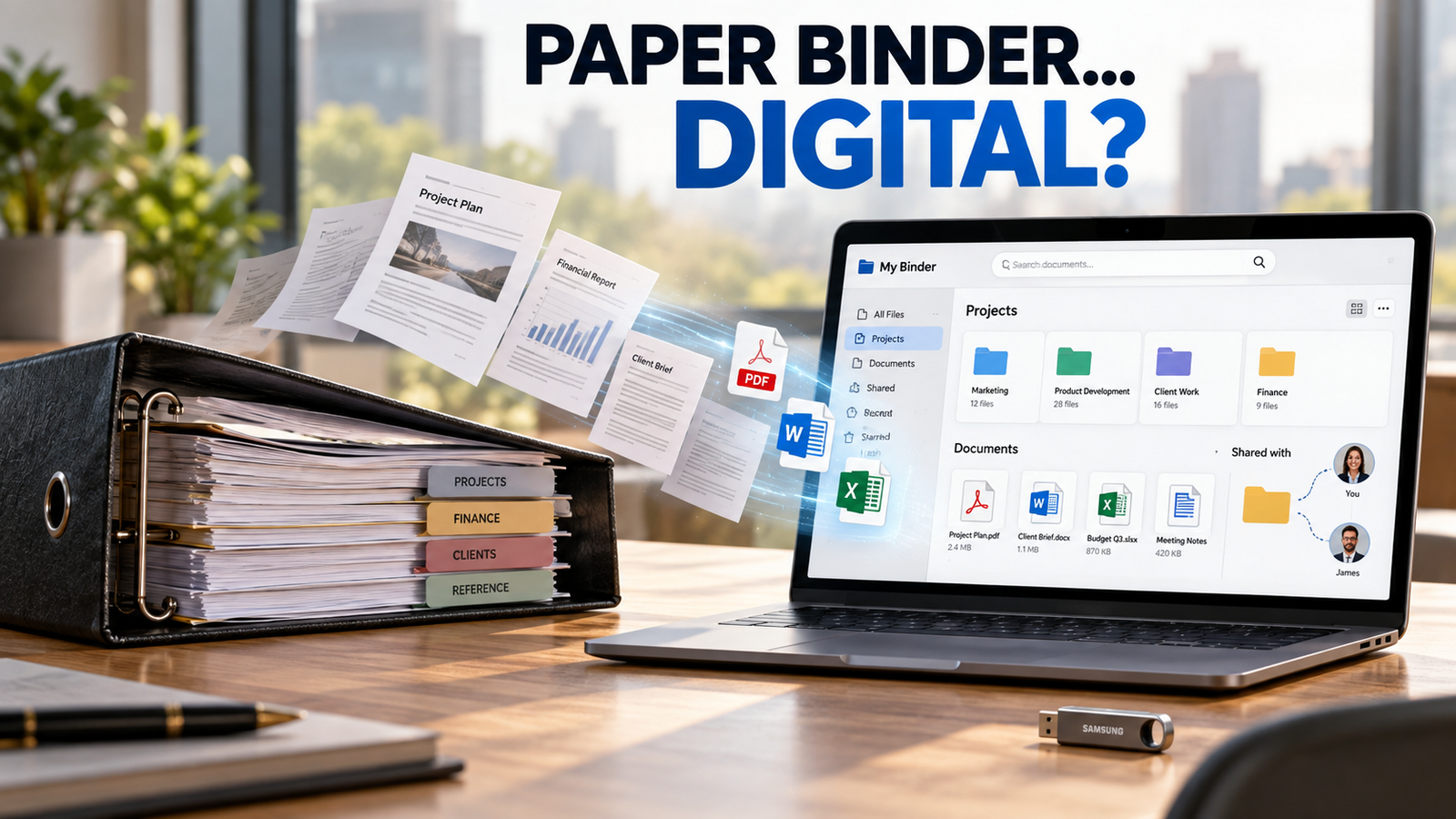
A digital binder is an electronic alternative to a traditional paper binder. Instead of storing documents in physical folders, a digital binder organizes files, documents, projects, and other information in a structured digital workspace.
Digital binders are part of the move toward a paperless office. They can help individuals, businesses, freelancers, and teams reduce the amount of paper they use while making documents easier to organize, access, and share.
A digital binder can be stored locally on a computer, on a network, or, depending on the solution, on a USB device or cloud environment.
Table of Contents
Digital Document Binder vs. Paper Binder
Traditional paper binders are simple, but they have several limitations. They take up physical space, can become difficult to organize, and are not convenient when several people need access to the same documents.
A digital binder replaces these physical folders with an electronic structure.
| Paper Binder | Digital Binder |
|---|---|
| Physical documents | Electronic documents |
| Requires storage space | Requires digital storage |
| Manual document filing | Digital organization |
| Difficult to share simultaneously | Files can be shared digitally |
| Paper copies can be lost or damaged | Digital backups can be created |
| Usually accessible only where the binder is located | Can be portable or network-accessible |
The goal is not simply to scan paper documents. A digital binder can provide a structured environment for managing electronic content and keeping related information together.
What Can Be Stored in a Digital Binder?
A digital document binder can contain many types of electronic content, including:
- PDF documents
- Word and Excel files
- Images and scanned documents
- Project files
- Emails
- Tasks and notes
- Calendars and schedules
- Business documents
- Contracts and forms
- Shared team files
Instead of having documents scattered across different folders, email accounts, and physical binders, a digital binder provides a central structure for organizing related information.
Digital Binder and File Sharing
One important advantage of a digital binder is file sharing.
In a traditional office, sharing a document may require making a copy, sending an email attachment, or physically handing over a folder. With a digital binder, documents can be made available to authorized users electronically.
For teams, a digital binder can provide:
- Shared document spaces
- User accounts
- Access permissions
- Structured project folders
- Electronic file sharing
- Collaboration between team members
This makes the concept particularly useful for small businesses and teams working with the same projects or documents.
Digital Binder for a Paperless Office
A paperless office does not necessarily mean that every physical document must disappear immediately. Instead, it means reducing unnecessary paper and moving everyday document management into digital workflows.
Replacing paper binders with digital binders can reduce physical storage requirements and make information easier to organize.
For example, instead of maintaining separate paper binders for:
- customers,
- projects,
- invoices,
- contracts,
- administration,
- and internal documents,
an organization can create corresponding digital binders or folders within an electronic document workspace.
This can make searching, organizing, backing up, and sharing information much easier.
Can a Digital Binder Work Offline?
Not every digital binder requires cloud storage.
Some digital binder solutions are designed to work offline, allowing documents to remain on a local computer, local network, or portable storage device.
This can be useful for users who want to keep control over where their documents are stored or who need access to documents without an internet connection.
For example, LOV111VOL is designed as a portable digital workspace that can run from a USB stick without requiring a server or permanent internet connection.
Digital Binder on a USB Stick
A portable digital binder can also be used from a USB stick.
The concept is straightforward: instead of carrying a physical binder containing dozens or hundreds of pages, the user carries a digital workspace containing electronic documents.
A USB-based digital binder can therefore combine:
Portability + digital document management + offline access.
LOV111VOL, for example, can be copied to a USB device and launched without a conventional installation.
Digital Binder for Teams
A digital binder can also be used as part of a digital office.
A team can create shared areas for projects and documents while controlling which users have access to specific information.
Depending on the software, features can include:
- User permissions
- Shared folders
- Encrypted file sharing
- Project organization
- Local or network access
- Offline document access
This makes a digital binder more than simply a replacement for a PDF folder. It can become a structured workspace for everyday business activities.
Why Replace a Paper Binder with a Digital Binder?
There are several reasons why individuals and organizations choose digital document management.
1. Less physical storage
Digital documents do not require shelves, cabinets, or office space for physical folders.
2. Easier organization
Documents can be arranged into digital folders, projects, categories, and workspaces.
3. Easier file sharing
Authorized users can share electronic documents without physically exchanging a binder.
4. Portability
A portable digital binder can contain a large amount of information while taking up very little physical space.
5. Offline access
Solutions designed for local use can provide access to documents even without an internet connection.
6. Digital backups
Electronic documents can be backed up to another secure storage location.
Is a Digital Binder the Same as Cloud Storage?
No.
Cloud storage is one possible way of storing digital documents, but a digital binder is primarily an organizational concept.
A digital binder focuses on how documents and related information are structured and managed. It can potentially use:
- Local storage
- A USB device
- A local network
- Cloud storage
- A combination of these methods
Therefore, a digital binder does not automatically mean that all documents must be stored in the cloud.
What Is an Electronic Document Binder?
The terms digital binder, electronic binder, and digital document binder are often used to describe similar concepts.
An electronic document binder organizes digital documents in a structure that resembles the organization of a physical binder, but with additional capabilities such as search, permissions, digital file sharing, backups, and integration with other digital office functions.
Instead of asking:
“Where is the paper binder?”
users can work with a digital workspace where the relevant documents and information are organized electronically.
The Future of Document Organization
The traditional paper binder remains useful in some situations, but modern offices increasingly depend on electronic documents.
A digital binder provides a bridge between the familiar concept of a physical binder and modern digital document management.
For individuals and teams looking for a paperless office, the digital binder concept offers a practical way to organize documents, share files, reduce physical storage, and work with information electronically.
Conclusion
A digital binder is an electronic alternative to a traditional paper binder. It organizes documents and other digital information in a structured workspace and can support file sharing, project organization, collaboration, and paperless office workflows.
Depending on the software, a digital binder can work online, offline, locally, over a network, or from portable storage such as a USB stick.
For users who want to replace paper binders with a more portable and organized digital solution, a digital binder can be a simple step toward a modern paperless office.
You can learn more about the LOV111VOL Digital Binder and its offline document workspace here:
