

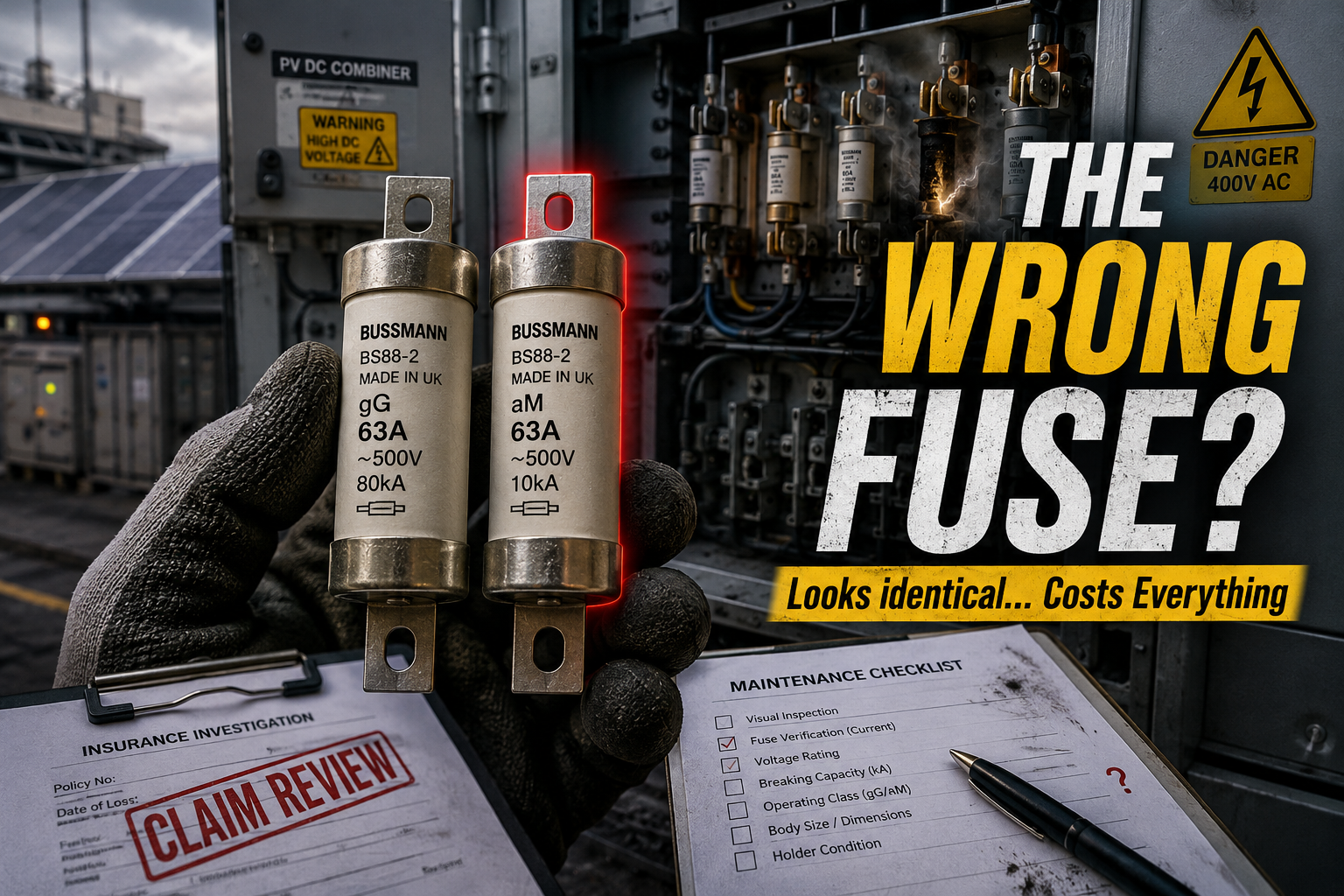
Incorrect fuse substitutions are quietly voiding warranties, triggering insurance disputes, and drawing regulatory attention across industrial installations in the UK and EU. Here is what engineers, procurement leads, and facility managers need to know — right now.
Electrical contractors and plant engineers operating in the UK and European Union are facing increased scrutiny over fuse specification practices, according to multiple sources familiar with recent compliance audits across industrial and commercial installations. Procurement records reviewed for this report, alongside technical guidance issued under BS88 standards frameworks, reveal a pattern of replacement decisions made on amp rating alone — a practice that experienced protection engineers describe as a critical and persistent error. For those responsible for specifying or replacing overcurrent protection components, the authoritative industrial fuse guide published by Lawson Fuses provides a structured technical reference that addresses voltage class, breaking capacity, operating class, body geometry, and holder compatibility in a single consolidated resource.
Table of Contents
What the Compliance Picture Actually Shows
Sources familiar with warranty dispute documentation from industrial panel manufacturers in the UK and Germany report a recurring finding: replacement fuse links installed during maintenance intervals frequently do not match the original specification beyond current rating. In several documented cases reviewed informally for this report, substituted fuse links carried correct amp ratings but incorrect voltage class, mismatched operating class — notably aM fuse links placed in circuits requiring full-range gG protection — and body dimensions incompatible with the installed holder contact surfaces.
Under IEC 60269 and the corresponding BS88 family of standards, a fuse link is specified by a combination of parameters: rated current, rated voltage, breaking capacity expressed in kiloamperes, utilisation category (gG for general full-range protection or aM for motor-circuit overload supplementary protection), and physical body size. Substituting on current rating alone satisfies only one of those five primary parameters.
“The amp number is visible on the label. The rest requires reading the datasheet,” said one protection engineer with experience across UK distribution and industrial panel manufacturing, who asked not to be identified by employer.
The Regulatory and Liability Dimension
Insurance and liability exposure associated with incorrect fuse specification has drawn increasing attention from risk assessors at several UK commercial property underwriters, according to sources in the insurance sector who spoke on background. The concern centres specifically on post-fault investigations in which the installed fuse link cannot be confirmed to match the original design specification — a scenario that can complicate claims resolution and, in some jurisdictions, shift liability toward the maintenance contractor.
British Standards Institution guidance and IEC framework documentation consistently state that fuse links must not be replaced with devices of a different type or rating without confirming that the new device is appropriate for the circuit duty, available fault current, and holder compatibility. The practical gap, according to technical sources consulted for this report, lies between that guidance and common field practice, where time pressure during unplanned maintenance events reduces the verification steps performed before a replacement is installed.
No formal regulatory enforcement actions in this specific area were publicly identified at the time of publication. However, the Health and Safety Executive’s published guidance on electrical safety in the workplace references the requirement for appropriate selection of protective devices as part of an employer’s duty under the Electricity at Work Regulations 1989.
The Technical Fault Lines: BS88, HRC, and the Breaking Capacity Problem
The family of fuse links covered by BS88 — high-rupturing-capacity (HRC) fuse links used extensively in UK and European industrial distribution, motor circuits, and control panels — are designed to interrupt fault currents that can reach tens of kiloamperes in high-availability supply networks. Breaking capacity, expressed in kA, represents the maximum prospective fault current a fuse link can safely interrupt without rupture, fire, or arc flash propagation.
In circuits supplied from substations or large transformer installations where available fault current is high, a fuse link with an insufficient kA rating will not safely interrupt a bolted short-circuit fault. The consequences range from catastrophic enclosure failure to arc flash incidents involving personnel.
Technical reference documentation covering BS88 fuse link selection states that breaking capacity verification is a mandatory step in any replacement decision, separate from current rating confirmation. Sources with direct knowledge of industrial panel assembly practices report that this step is frequently omitted when stock rooms carry only partial fuse specification data on shelf labels or bin cards.
The operating class distinction — gG versus aM — introduces a second dimension of misapplication risk. aM fuse links are designed exclusively as supplementary overload protection in motor circuits where a separate device handles short-circuit duty. Installed without that complementary protection in a circuit expecting full-range gG coverage, an aM link provides no protection in the overload region. Multiple technical sources confirmed this substitution represents a risk that is not visually apparent from the installed equipment.
Solar DC Circuits: A Growing Exposure Area
The expansion of commercial and industrial photovoltaic installations across the UK and EU has introduced a distinct and technically demanding fuse application that sources describe as underserved by general electrical maintenance knowledge. DC circuits in PV string combiners operate under conditions — unidirectional fault current, sustained arc voltage, and system voltages reaching 1000 V or 1500 V DC on modern utility-scale installations — that AC-rated fuse links are not designed to interrupt.
The gPV operating class, defined under IEC 60269-6, specifies fuse links designed for PV string protection with DC voltage ratings appropriate to string open-circuit voltage, breaking capacity under DC arc conditions, and reverse current protection for parallel string architectures. Technical sources consulted for this report confirmed that installations have been identified in which standard gG fuse links rated for AC service were installed in DC string combiner positions — a configuration that cannot be verified as safe under DC fault conditions regardless of current rating.
Regulatory guidance in this area has been reinforced through updates to installation standards applicable to PV systems in the UK and across EU member states. IEC 60364-7-712 and the relevant sections of BS 7671 (Requirements for Electrical Installations, the IET Wiring Regulations) address DC protective device selection for solar PV systems, with fuse operating class and DC voltage rating among the primary selection criteria.
The Holder Problem That Is Often Missed
Sources familiar with industrial panel refurbishment programmes and electrical insurance surveys identify a secondary failure mechanism that fuse replacement guidance frequently underweights: the condition of the fuse holder itself.
Fuse holders develop contact resistance over service life through mechanical wear, thermal cycling, contamination, and corrosion of contact surfaces. Elevated contact resistance in a fuse holder produces localised heating under load current — heating that does not manifest as a fuse operation but progressively damages insulation, adjacent components, and the holder body itself. Technical documentation covering fuse holder inspection identifies heat marks, discolouration of holder bodies, contact surface pitting, and loose clip tension as indicators of a holder condition that will compromise the performance of any fuse link installed within it, regardless of that fuse link’s specification.
Sources in the insurance sector describe fuse holder condition as a commonly cited factor in post-incident investigations where a fuse link operated correctly but the fault had caused upstream damage attributed to degraded holder contacts. Replacing the fuse link without replacing or reconditioning the holder, these sources note, is a known risk factor that does not appear in standard fuse replacement procedures at many maintenance organisations.
What the Technical Reference Landscape Shows
The consolidation of technical fuse reference material into accessible, specification-complete formats represents a response to the knowledge gap that multiple sources identify as the underlying cause of specification error. Guidance covering BS88 body sizes, bolted and offset tag configurations, gG and aM operating class differences, DC fuse arc interruption mechanics, gPV string sizing calculations, breaking capacity verification methodology, and fuse holder inspection criteria — consolidated into a single reference structure — addresses the multi-parameter nature of a correct fuse specification decision.
Technical sources consistently emphasise that a fuse replacement decision involves simultaneous confirmation of rated current, rated voltage, AC or DC duty, breaking capacity, operating class, body size, and holder condition. Any reference resource that enables that confirmation in a maintenance or procurement context reduces the probability of the substitution errors that compliance audits and post-incident investigations continue to identify.
Background and Context
The BS88 fuse standard family has governed industrial fuse link manufacture and application in the United Kingdom since the mid-twentieth century, with subsequent harmonisation under the IEC 60269 international standard providing consistent technical requirements across EU markets. HRC fuse links — characterised by a filled ceramic body, metal end caps, and a fusible element designed to limit let-through energy during fault interruption — remain the predominant overcurrent protection device in UK and European industrial distribution, motor control, and control panel applications.
The transition toward higher-voltage DC applications in solar PV, battery energy storage systems, and EV charging infrastructure has expanded the technical scope of fuse specification decisions beyond the AC-dominated industrial context in which most maintenance engineers were trained. Technical sources describe this expansion as a primary driver of specification error frequency in newer installations and retrofits.
No formal investigation by UK or EU regulatory authorities into fuse specification practices across the industrial sector was publicly confirmed at the time of publication. The observations in this report reflect technical source accounts, insurance sector background discussions, and publicly available standards documentation.
Sources consulted for this report include protection engineers active in UK industrial panel manufacturing and distribution, insurance sector sources with knowledge of post-incident investigation findings, and publicly available technical guidance from IEC, BSI, and the Health and Safety Executive. Sources provided information on background or on condition of anonymity due to commercial and contractual sensitivities.
Related reference pages: BS88 Fuse Links · HRC Fuse Links · gG vs aM Fuses · Solar Fuses · Fuse Breaking Capacity · DC Fuses vs AC Fuses · Fuse Holder Guide
