
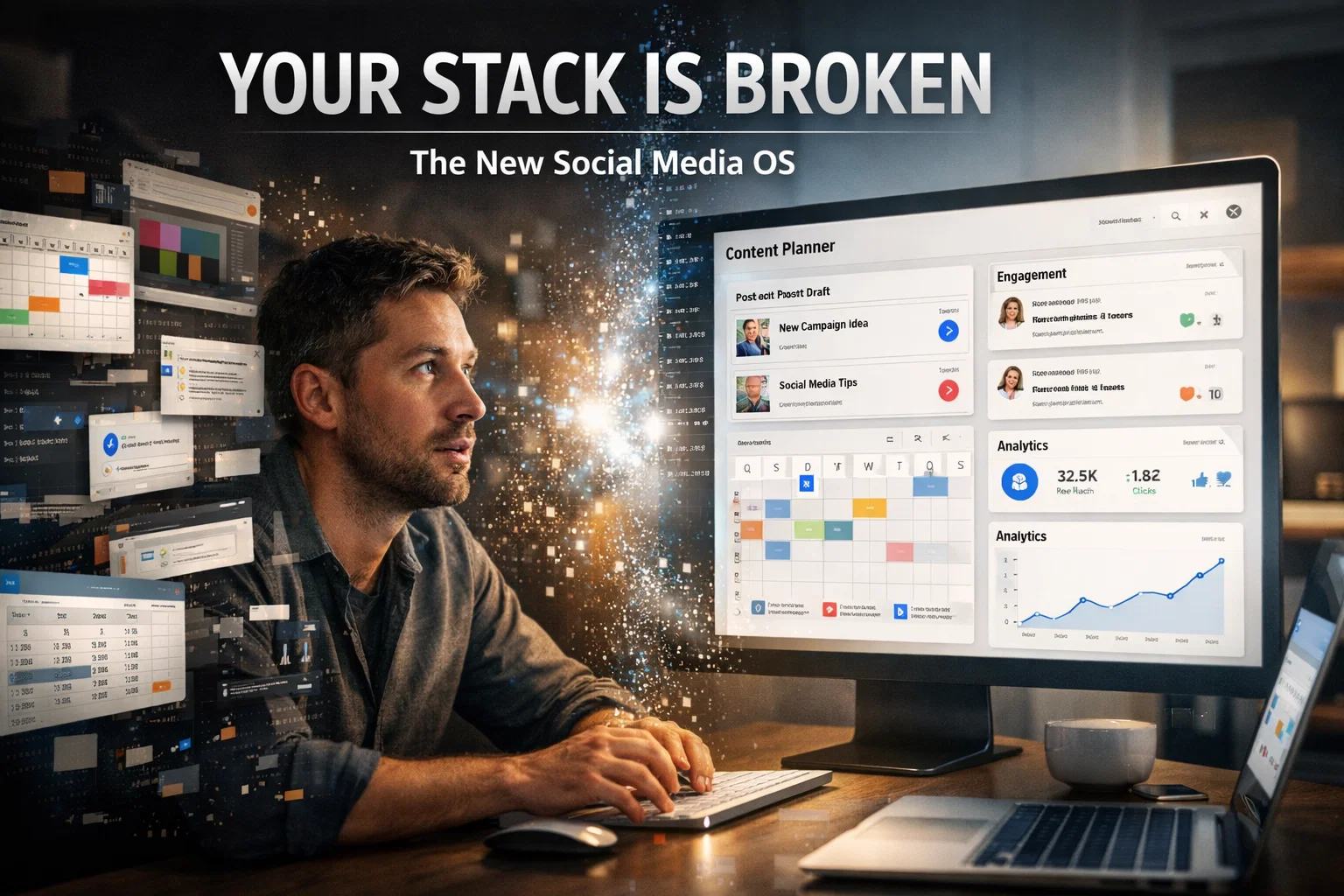
For years, social media management meant a scheduler, a design tool, a note-taking app, and a spreadsheet. In 2026, that stack looks unfinished. Meta’s Q4 2025 results showed ad impressions up 18% year over year, while Alphabet said YouTube’s annual revenue surpassed $60 billion and Shorts now averages more than 200 billion daily views. When distribution surfaces are this large and this fast, execution software has to behave like an operating system, not a utility.
That is why the category is converging. Products like Crowbert are being positioned less as one-function schedulers and more as full workflows for content, publishing, engagement, and reporting. Crowbert’s feature set for AI content, scheduling, and analytics reflects the broader shift: the value is no longer in one isolated capability. It is in how tightly the steps connect.
This is a bigger change than a feature expansion. It changes how teams buy, evaluate, and operate marketing software.
Table of Contents
Why the Old Stack Is Breaking
A fragmented stack creates 3 predictable problems:
- Context loss between ideation, production, and publishing
- Approval drag caused by handoffs between tools
- Weak learning loops because performance data lives somewhere else
At low volume, teams tolerate that friction. At higher volume, the friction becomes the main cost. A team shipping 20 posts a week can easily touch 4 or 5 tools per asset. That is 80 to 100 context shifts every week before comments, replies, or reporting are even counted.
The 5 Layers of the New Operating System
1. Idea Capture
The system should turn sales notes, customer objections, launch updates, and trend observations into reusable content inputs. If ideas remain trapped in meetings or Slack threads, the engine stays underfed.
2. AI-Assisted Drafting
Drafting now includes hooks, channel variants, CTA options, and content expansions. The value is not only that AI writes faster. It is that the software can retain the campaign context while doing it.
3. Scheduling and Publishing
The scheduler is still important, but it is no longer the center of the product. It is one layer in a bigger execution loop. Posting across 4 to 8 channels from one workspace matters because channel volume is rising and teams need a single source of truth.
4. Engagement
Brands now need to treat replies, comments, and follow-up conversations as part of the content system. If publishing sits in one tool and engagement sits in another, the feedback loop slows down.
5. Analytics
Reporting is only useful when it feeds the next draft. The best modern platforms close that loop in days, not weeks. Performance should influence the next batch of hooks, formats, and CTAs inside the same environment.
The Economics of Convergence
Let us compare two models. In model A, a team uses 5 separate tools and spends 9 minutes transferring, checking, or recreating context per asset. At 25 assets a week, that is 225 minutes, or 3.75 hours. Over 52 weeks, that becomes 195 hours. In model B, the team reduces the context tax to 3 minutes per asset through tighter workflow. That is 65 hours a year. The difference is 130 hours, roughly 16 full workdays.
Software categories converge when coordination cost becomes too visible to ignore. That is what is happening here.
How Buyers Should Evaluate the New Category
Most feature lists still lead with posting. That is outdated. In 2026, buyers should score platforms on 10 criteria:
- How quickly does an idea become a draft?
- Can channel variants be created without starting over?
- How many review steps happen inside the system?
- Can the calendar reflect campaign-level priorities?
- Is engagement connected to publishing history?
- Can performance data inform future drafts?
- How many users can collaborate cleanly?
- How many channels are supported from one dashboard?
- How well does the workflow preserve brand voice?
- How much manual stitching is still required?
If a platform scores well on features but poorly on workflow continuity, the team will still feel slow.
What This Means for Teams
The operating system model changes role design. A content lead no longer needs to orchestrate every micro-step manually. A designer can contribute fewer but better assets because the copy and scheduling system is tighter. A founder can review one workflow instead of chasing context across 3 apps and 2 meetings. In practical terms, a 3-person team can often execute like a 5-person team when the operating loop is integrated.
A 30/60/90-Day Rollout Plan
- First 30 days: centralize ideation, drafting, and scheduling
- Next 30 days: standardize approvals and basic analytics reviews
- Final 30 days: connect insights from engagement and reporting back into content production
By day 90, the goal is not “more software usage.” The goal is a shorter loop from idea to learning.
The Strategic Shift
When software becomes an operating system, the purchase decision gets more strategic. You are not just choosing where posts get scheduled. You are choosing where knowledge accumulates. Over 6 months, the better system learns what your audience responds to, what proof moves them, and what formats repeatedly perform. That learning becomes an advantage competitors cannot copy by buying the same AI model.
Final Takeaway
Social media management is not disappearing. It is being redefined. The next generation of winners will look less like isolated tools and more like operating environments for marketing execution. In 2026, that is the real category shift: the best software does not just help teams post. It helps them run the entire loop.
