

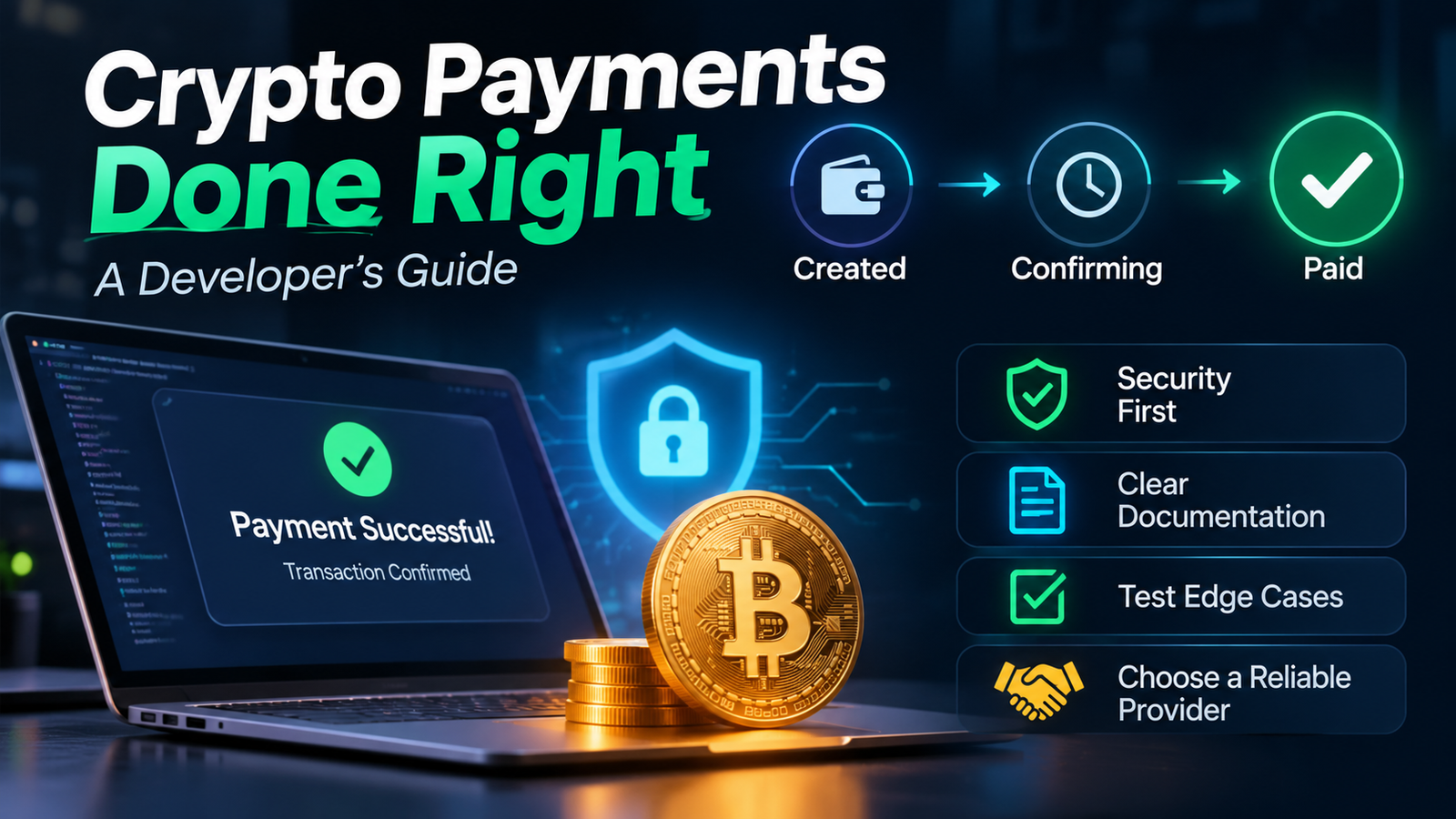
Adding crypto payments to an application involves far more than displaying a wallet address. A crypto payment API has to create the payment, monitor the blockchain, handle confirmations, notify your application, and stay reliable when networks are congested or a customer sends the wrong amount. For developers, the quality of that API decides whether the integration takes an afternoon or becomes an ongoing source of support tickets.
Table of Contents
Understand the crypto payment lifecycle
A crypto payment is not a single event. It moves through states such as created, waiting, confirming, partially paid, paid, expired, or cancelled. A good API exposes each state clearly and lets your application react without constant polling. Webhooks are the usual mechanism, but they need to be signed, retried on failure, and safe to process more than once.
Idempotency matters just as much. If your application retries a request after a timeout, the API should return the original payment rather than create a second one. Without idempotency, a brief network glitch can produce duplicate orders and confused customers.
Authentication and security essentials
API keys should be scoped to the merchant account and easy to rotate. All requests should use HTTPS, and webhook payloads should be signed with a shared secret. Your application should verify that signature and reject stale timestamps to prevent replay attacks. For production payments, none of this is optional.
The API should also keep sensitive data out of URLs and logs. Create payments server-side, never in the browser, because a key embedded in client-side code can be extracted. Many providers offer a hosted checkout page, which keeps wallet handling and payment display off your own infrastructure and reduces the surface area you have to secure.
Documentation, SDKs, and versioning
Good documentation is part of the product. Look for a clear quick start, complete request and response examples, documented error codes, and a sandbox or test mode. SDKs for common languages reduce boilerplate, but they shouldn’t hide the underlying API. When something fails, developers need to understand exactly what the SDK is doing.
Predictability is just as important. Consistent naming, stable versioning, and a public changelog make upgrades safer. If a provider renames a field or a status without warning, every downstream integration can break.
Test the edge cases before going live
A payment API is only as good as its behaviour in unusual situations. Test a partial payment, an expired payment, a payment sent on the wrong network, and a webhook delivered twice. Check what happens when a customer closes the checkout page and returns later. Your application should never fulfil an order simply because the customer reached a success URL. Always confirm the final status through a verified webhook or an API call.
Hosted providers can take some of this work off your plate. For example, a hosted crypto payment API such as Coino Live creates the payment server-side, returns a checkout URL, exposes payment status through the API, and sends signed webhooks. It offers a REST API and SDKs, with a platform fee of 0.25% per payment. Whichever provider you evaluate, you still need to manage order state correctly on your side. The provider supplies the payment infrastructure, not your business logic.
The bottom line
The best crypto payment API makes the happy path simple and the unhappy paths explicit. When comparing options, look for a clear payment lifecycle, idempotent requests, signed webhooks, solid documentation, and a test mode that lets you trigger failures before real money is involved. A good integration should reduce complexity, not hide it.
