

Upgrading aging municipal infrastructure, expanding healthcare campuses, and reconfiguring multi-story commercial buildings present unique engineering hurdles when structural alterations are required. Unlike greenfield construction where utility layouts are freshly documented, existing reinforced concrete structures often lack accurate as-built blueprints. Over decades of occupancy, slabs and load-bearing walls accumulate undocumented electrical conduits, communication lines, plumbing runs, and post-tensioned reinforcement systems. Cutting or breaching these dense structural elements without absolute certainty of internal conditions risks catastrophic structural compromise, prolonged utility outages, and severe safety incidents. To execute complex structural retrofits safely, general contractors and structural engineers combine high-precision radiographic imaging with specialized diamond sawing operations.
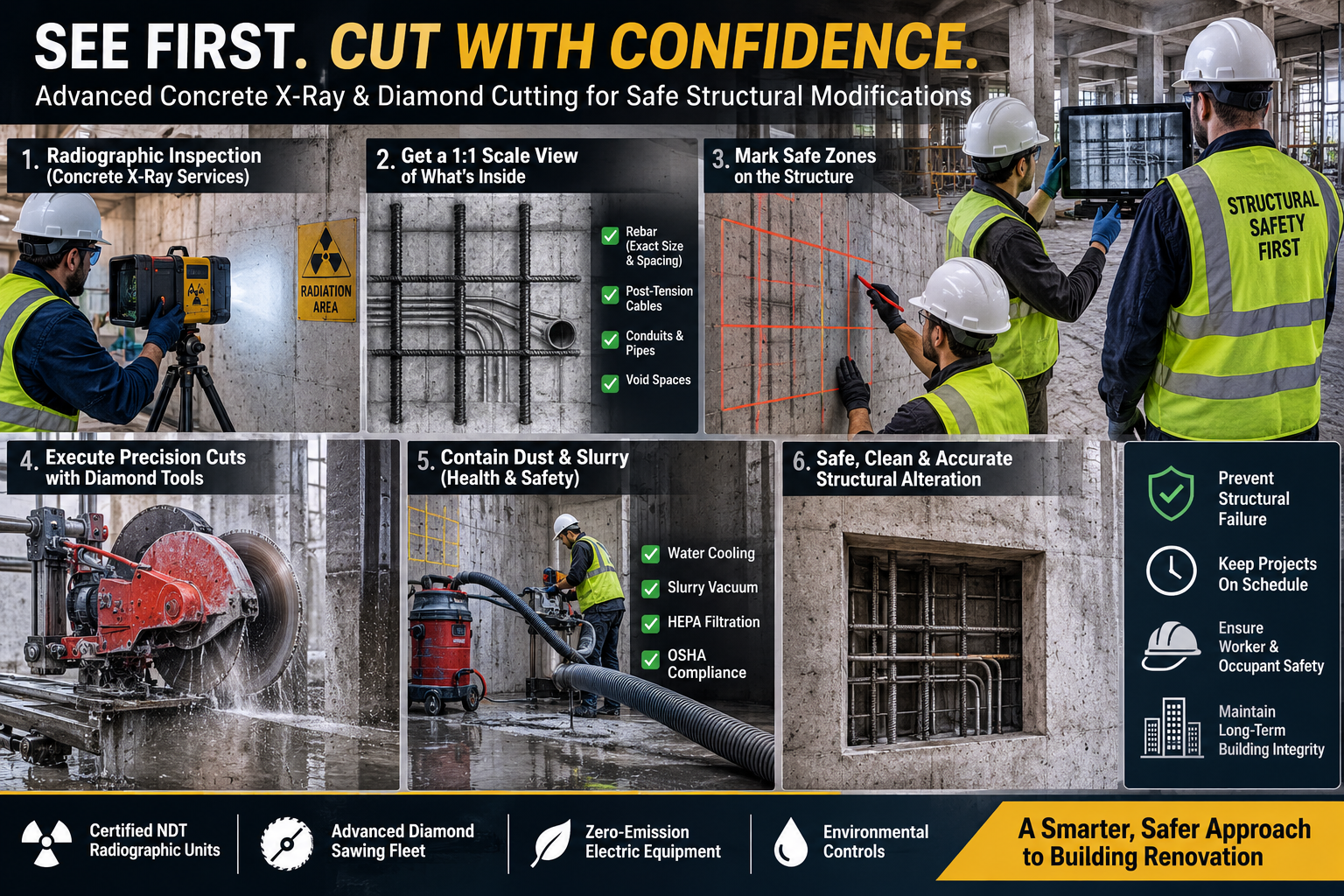
Before any mechanical blade contacts a structural wall or elevated slab, engineering teams establish complete internal visibility through specialized concrete xray services. Radiographic inspection transmits controlled gamma radiation through the concrete matrix onto a digital imaging plate positioned on the opposing side, generating a true one-to-one scale silhouette of embedded components. Unlike surface-level electromagnetic sensors that can experience signal interference in heavily congested reinforcement zones, radiography penetrates dense concrete to reveal exact rebar diameters, multi-layered spacing, post-tension cable anchors, metallic conduits, and internal air voids. Certified technicians establish strict radiation safety perimeters during exposure cycles, ensuring complete protection for facility occupants and field personnel. Once the radiograph is processed, engineers verify exact clearance zones and transfer precise boundary markings directly onto the concrete surface, eliminating guesswork prior to structural modification.
With verified drill-safe and cut-safe zones mapped onto the structure, project managers deploy experienced concrete cutters to execute clean, vibration-free structural openings. Utilizing track-mounted wall saws, high-torque flat saws, and diamond wire systems, specialized operators slice through heavily reinforced concrete walls, bridge decks, and foundation slabs with exact geometric accuracy. Water-cooled diamond segments grind smoothly through high-PSI aggregate and heavy steel rebar without transmitting destructive shockwaves into adjacent structural members, preserving the integrity of remaining load-bearing columns and beams. Furthermore, professional cutting crews integrate continuous slurry containment vacuums and HEPA filtration systems directly at the cutting interface, capturing wet concrete residue and crystalline silica dust to ensure strict compliance with OSHA air quality standards inside occupied hospitals, laboratories, and commercial towers.
Coordinating radiographic diagnostics directly with diamond cutting execution streamlines project logistics and eliminates costly third-party scheduling bottlenecks. When subsurface imaging and mechanical cutting are managed under a unified technical workflow, field crews can immediately adapt cut lines if unexpected utility conduits or structural anomalies appear on the radiograph. This integrated approach prevents accidental severing of tensioned steel tendons, avoids expensive emergency utility repairs, and keeps critical path construction schedules intact across complex commercial renovations.
Ultimately, protecting structural longevity during major building modifications requires replacing assumptions with verified radiographic data and non-impact diamond tooling. Partnering with specialized contractors equipped with certified NDT radiographic units, high-capacity wall and slab sawing fleets, zero-emission electric equipment, and source-capture environmental controls guarantees that demanding structural alterations proceed cleanly, safely, and strictly according to ACI engineering specifications.
