

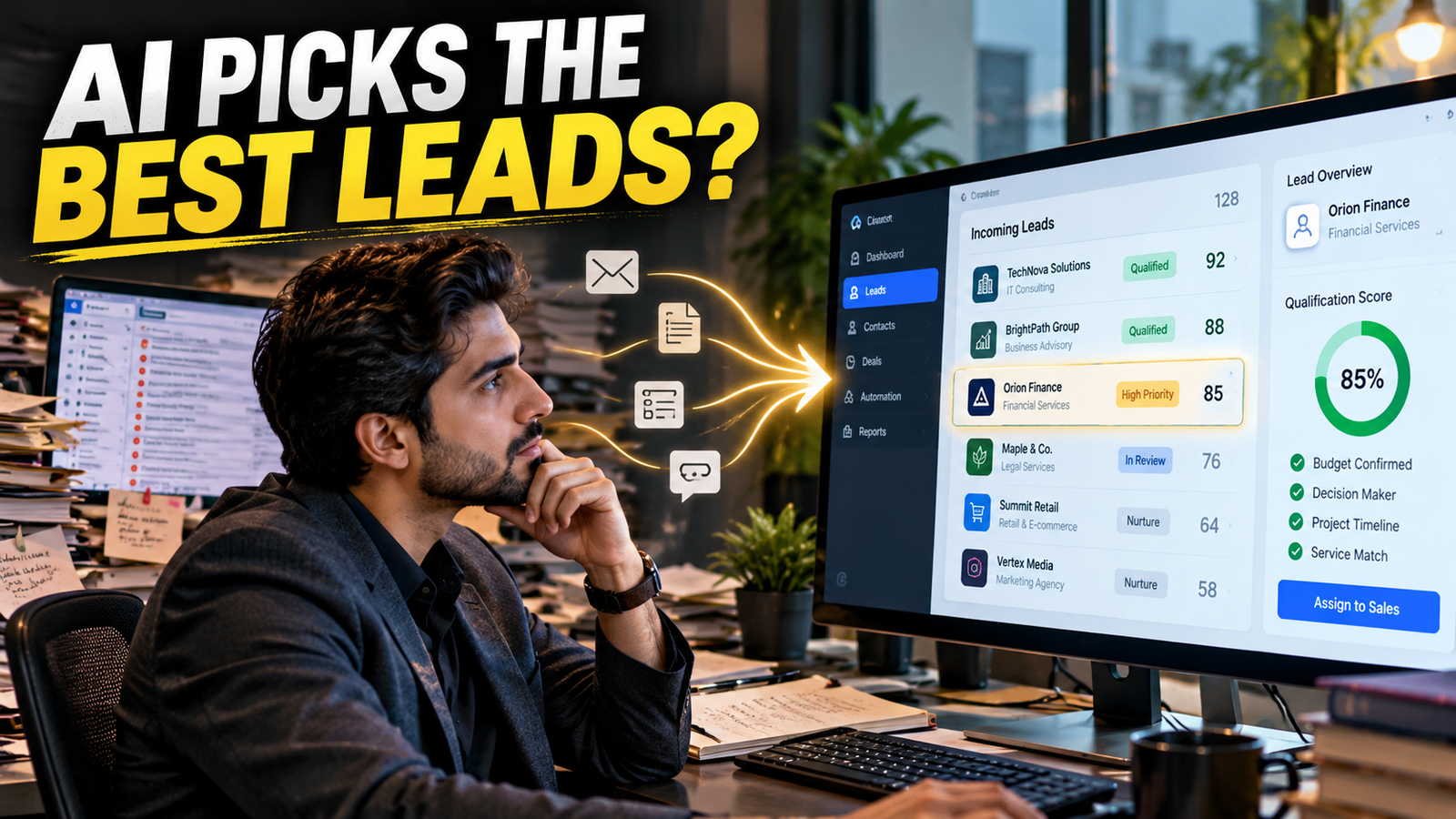
An enquiry arrives through a website form, another lands in a shared inbox, and a third comes through a referral. Each represents a potential business opportunity, yet identifying which deserves immediate attention can take longer than expected. A carefully designed AI lead qualification pilot offers businesses a practical way to test automated lead assessment before committing to a larger implementation. The Forfis AI integration agency also demonstrates how artificial intelligence can connect with existing CRM platforms, communication tools, and internal knowledge systems to improve workflows without requiring companies to replace their established software.
For professional services firms, consultancies, and B2B organisations, the challenge is rarely just generating enquiries. It is determining which prospects genuinely need their services, collecting the right information, and ensuring that the appropriate team member responds at the right time.
Artificial intelligence can support this process, but its effectiveness depends on how well it fits into the existing sales operation.
Table of Contents
Why Traditional Lead Qualification Creates Operational Bottlenecks
Consider a consultancy receiving enquiries from businesses of different sizes, industries, and geographical locations.
Some prospects are actively searching for a service provider. Others are collecting information for projects that may not begin for several months. A few may be contacting the wrong department altogether.
In a traditional workflow, an employee must read each enquiry, review available information, ask follow-up questions, assess its commercial relevance, and enter the findings into a customer relationship management system.
This approach becomes difficult to maintain as enquiry volumes increase.
Several problems commonly emerge:
- Delayed responses: Promising enquiries remain unanswered while employees process other requests.
- Inconsistent assessments: Different sales representatives may interpret qualification criteria differently.
- Incomplete CRM records: Important details disappear between emails, spreadsheets, and internal conversations.
- Repetitive administrative work: Employees spend valuable time collecting information rather than developing client relationships.
- Poor lead visibility: Managers struggle to understand why certain enquiries advance while others receive little attention.
Hiring additional staff may reduce the immediate workload, but it does not necessarily correct the underlying process.
A more sustainable solution begins by examining how information moves between the prospect, the sales team, and the organisation’s internal systems.
What AI Lead Qualification Actually Does
AI lead qualification uses artificial intelligence to help evaluate incoming enquiries against predefined business requirements.
Unlike a conventional contact form, an AI-assisted system can interpret written responses, identify missing information, and suggest appropriate next steps.
For example, a business consultancy might need to establish whether a prospect has a relevant commercial requirement, an appropriate project budget, a realistic implementation timeline, and authority to participate in purchasing decisions.
An AI agent could review the enquiry and identify which of these details are already available.
If the prospective client provides insufficient information, the system might prepare a clarification question for approval or ask an authorised follow-up question automatically.
The result is a more structured qualification process that produces useful information rather than simply assigning an unexplained score.
However, qualification should not be confused with predicting whether someone will definitely become a customer.
A prospect may appear suitable but never purchase. Another may initially provide limited information and eventually become a valuable client.
For this reason, AI assessments should remain transparent, reviewable, and open to correction.
The Three Technologies Behind an Effective Qualification System
Successful AI qualification typically combines several technologies instead of relying on a chatbot alone.
1. Conversational AI for collecting information
Conversational AI allows prospects to describe their requirements naturally.
Rather than forcing visitors through a lengthy questionnaire, a conversational agent can gather relevant details gradually.
For instance, if someone enquires about financial consulting services, the agent might ask about the organisation’s immediate challenge, the type of support required, and the expected project timeline.
The conversation should remain focused on information that helps determine the next appropriate step.
Asking unnecessary questions can frustrate prospects and create additional data-management responsibilities.
2. Retrieval-Augmented Generation for reliable business knowledge
Retrieval-Augmented Generation, commonly called RAG, connects a language model to relevant information from an organisation’s knowledge sources.
These sources might include service descriptions, onboarding procedures, internal policies, eligibility rules, and approved pricing guidance.
When a prospect asks whether a particular service is available, a RAG-enabled system can retrieve relevant information before generating its response.
This is particularly valuable for organisations with complex services or frequently updated business documentation.
However, retrieval does not guarantee accuracy. Documents may be outdated, contradictory, or incomplete.
Businesses should therefore maintain approved knowledge sources, track document versions, and prevent the system from inventing commitments when reliable information is unavailable.
3. CRM integration for operational continuity
Collecting information has limited value if employees must manually transfer it into another system.
CRM integration allows an authorised workflow to connect qualification findings with customer records, sales assignments, and follow-up activities.
A well-designed integration can prepare or update fields such as:
- Prospect organisation and contact information.
- Requested service and business requirements.
- Qualification status and supporting evidence.
- Missing information requiring clarification.
- Assigned sales representative.
- Recommended next action and follow-up date.
An essential distinction is that the CRM remains the operational system of record.
The AI agent interprets information and recommends actions, while validated integrations handle changes to business records under defined permissions.
This separation helps prevent duplicate records, missing context, and uncontrolled updates.
What an AI-Assisted Lead Qualification Workflow Looks Like
Imagine a mid-sized management consultancy receiving an enquiry from a company interested in improving its financial reporting processes.
The following scenario is illustrative rather than a claim about a particular company’s results.
Step 1: Capture the enquiry
A prospect submits a website form describing difficulties with monthly financial reporting.
The system records the submission and checks whether an existing CRM entry already matches the organisation or contact.
Step 2: Identify the business requirement
An AI agent examines the enquiry and identifies financial reporting as the primary service requirement.
It extracts relevant information, such as the company’s stated size and implementation urgency, while marking missing details as unknown.
Step 3: Check service suitability
The agent consults approved internal documentation to establish whether the request falls within the consultancy’s service offering.
If the information is unclear, the enquiry is marked for review rather than automatically rejected.
Step 4: Determine the next action
The workflow applies established routing rules.
Suitable enquiries with sufficient information may be sent directly to the relevant sales queue. Enquiries requiring clarification enter a separate follow-up queue.
Step 5: Prepare the handover
The assigned consultant receives a structured summary explaining the prospect’s requirements, the available evidence, outstanding questions, and recommended next action.
Instead of searching through multiple messages, the consultant can begin preparing for a meaningful conversation.
The important improvement is not simply faster classification. It is the creation of a consistent handover that employees can understand and act upon.
How to Launch a Two-Week AI Qualification Pilot
Organisations do not need to automate every sales activity at once.
A limited pilot offers an opportunity to determine whether the proposed workflow is commercially useful, technically reliable, and acceptable to the employees who will use it.
Week One: Define the process and test the system
Begin with one enquiry source and one clearly defined service category.
The project team should document what qualifies a prospect for human follow-up, which information is mandatory, and which circumstances require escalation.
Next, examine existing CRM records and identify common data problems.
A technically sophisticated model cannot compensate for unclear qualification rules or unreliable customer records.
The team can then configure the AI agent, connect approved knowledge sources, and test the integration using historical or synthetic enquiries.
Testing should include unusual situations, such as incomplete submissions, contradictory answers, duplicate enquiries, and requests outside the firm’s services.
Week Two: Evaluate performance under supervision
During the second week, the system can operate in shadow mode, generating recommendations without changing live CRM statuses or sending messages.
Employees compare these recommendations against their own assessments.
Where testing and approvals permit, the organisation may introduce a limited live workflow with appropriate safeguards.
The team should record incorrect classifications, unnecessary follow-up questions, integration failures, and occasions when a human overrides the AI recommendation.
At the end of the pilot, decision-makers should have enough evidence to determine whether broader deployment is justified.
Two weeks will not necessarily establish long-term revenue impact, especially in industries with lengthy sales cycles. It can, however, reveal whether the system reliably completes the operational task it was designed to support.
How to Measure Whether the Automation Is Working
Automation should be evaluated through measurable business outcomes rather than the number of tasks it performs.
Useful pilot metrics include:
| Metric | What it reveals |
|---|---|
| First-response time | How quickly prospects receive an appropriate response |
| Qualification accuracy | How often AI recommendations match reviewed business criteria |
| Manual handling time | Employee time required to process each enquiry |
| CRM completeness | Whether essential qualification information is recorded |
| Incorrect rejection rate | How frequently potentially suitable enquiries are classified incorrectly |
| Human escalation rate | How often the workflow requires employee intervention |
| Qualified-to-meeting conversion | Whether accepted leads progress to meaningful sales conversations |
These measures should be compared against a baseline collected before implementation.
It is also important to distinguish a successful technical action from a successful business outcome.
For example, an automated CRM update may complete without errors while assigning a prospect to the wrong representative.
A meaningful evaluation must examine both system reliability and the quality of the resulting sales handover.
Why Human Oversight Still Matters
AI can process routine information efficiently, but professional services often involve complex commercial relationships.
A prospect seeking legal, financial, or strategic advice may have requirements that cannot be adequately interpreted through a brief online interaction.
An automated system could misunderstand an unusual project description or classify a valuable opportunity incorrectly because it does not match established patterns.
Businesses should therefore decide in advance which activities the AI system may perform independently and which require approval.
Routine information extraction and draft preparation may be suitable for automation.
Pricing exceptions, contractual commitments, sensitive communications, and disputed qualification decisions generally warrant closer human involvement.
Privacy is equally important.
UK organisations using personal data in AI-enabled sales workflows need to assess their obligations under applicable data protection rules. Marketing communications must also account for the Privacy and Electronic Communications Regulations, including the distinctions between different types of business subscribers.
A responsible implementation should limit access to customer information, retain appropriate records, and provide a mechanism for employees to identify and correct mistakes.
These safeguards are not obstacles to automation. They are necessary for maintaining confidence in a system that influences commercial relationships.
Common Mistakes That Undermine AI Qualification Projects
Some automation initiatives disappoint because organisations concentrate on selecting an AI model before understanding the underlying workflow.
Automating an undefined process
If employees disagree about what makes a qualified lead, the AI system has no reliable policy to follow. Qualification criteria should be documented and approved before implementation.
Using disconnected business information
An agent that cannot access current service documentation or validated CRM records may produce recommendations based on incomplete context.
Treating every enquiry as a sales opportunity
Not all incoming messages belong in the sales pipeline. Partnership requests, support enquiries, and unrelated submissions may require completely different workflows.
Allowing uncontrolled follow-ups
Automatically generated communication can damage trust when it contains incorrect assumptions or excessive requests for information. Outbound actions should follow approved communication rules.
Measuring activity instead of business value
Processing more enquiries is not necessarily an improvement if the system increases errors or creates additional work for employees.
Successful automation reduces unnecessary effort while preserving the quality of decisions and customer interactions.
When Should a Business Expand Beyond the Pilot?
A broader implementation becomes reasonable when the pilot demonstrates consistent performance against its agreed success criteria.
Before expansion, the organisation should confirm that qualification recommendations are explainable, CRM records remain accurate, and employees know how to handle exceptions.
The team should also understand the operating costs of the system, including model usage, integrations, monitoring, maintenance, and human review.
Once a lead qualification workflow performs reliably, similar principles may be applied to other operational activities.
These could include customer support triage, document classification, client onboarding, appointment coordination, and internal knowledge retrieval.
Each expansion should have its own process definition and measurable outcomes.
Automating five poorly understood workflows is unlikely to create more value than automating one important workflow properly.
The Future of Lead Qualification Is Better Decision Support
AI will continue to change how businesses organise customer information, prioritise enquiries, and coordinate sales activity.
Yet the greatest opportunity may not be eliminating every manual interaction.
It may be ensuring that people spend less time gathering scattered information and more time understanding what prospective clients actually need.
A well-designed AI qualification system can help organisations identify relevant enquiries, ask useful questions, maintain more complete records, and provide employees with the context required for effective follow-up.
The technology becomes valuable when these capabilities work together as part of an accountable business process.
For organisations considering their first automation project, the sensible starting point is a clearly defined problem, a manageable pilot, and measurable criteria for success.
The objective is not to create an entirely automated sales department. It is to build a dependable process in which artificial intelligence handles appropriate repetitive tasks while employees retain responsibility for the decisions and relationships that matter most.
