

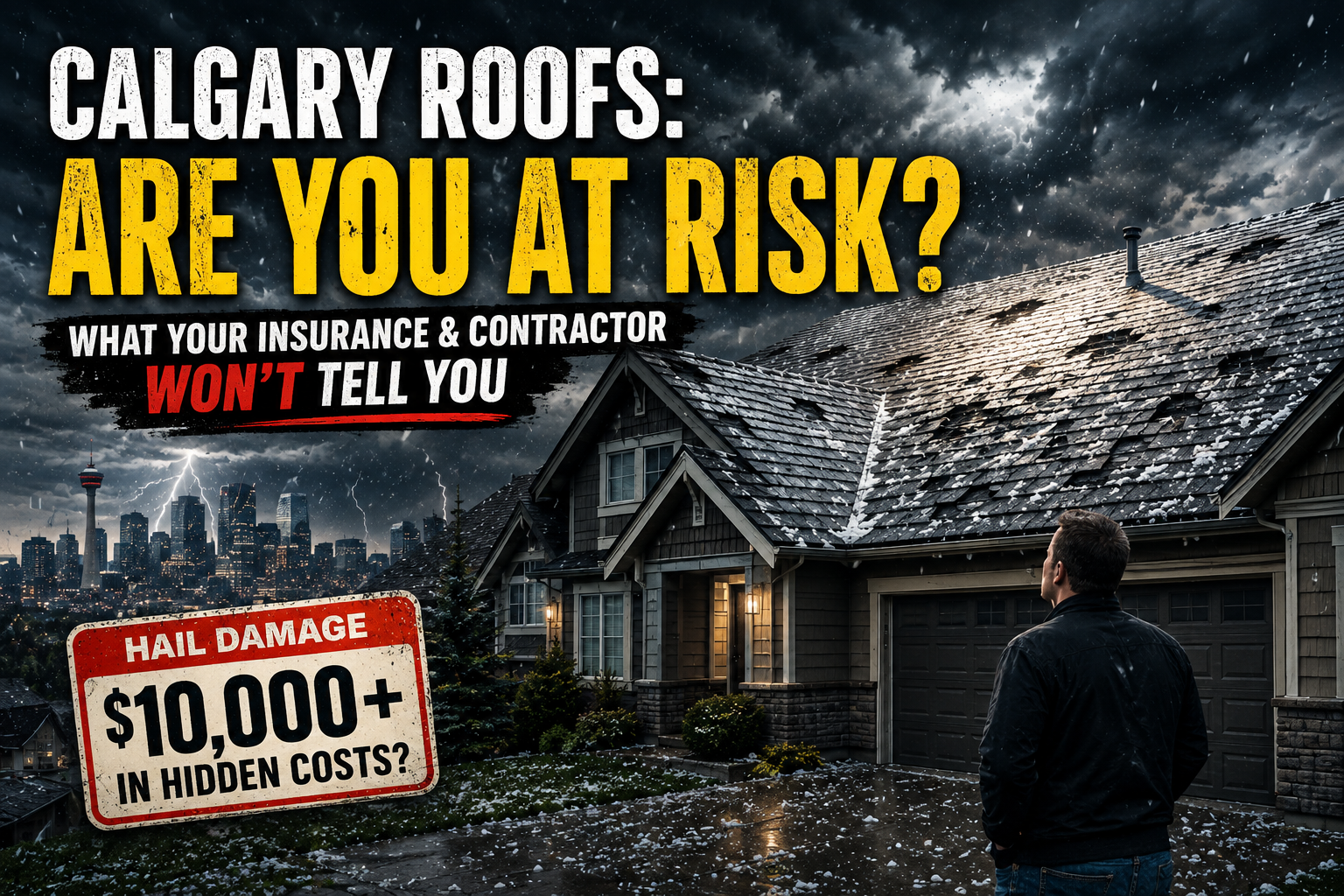
Calgary sits in the most hail-damaged residential market in Canada. Before you hire anyone to work on your roof, verify four things: a provincial prepaid contracting licence (required in Alberta for any contractor who takes a deposit), a City of Calgary business licence, WCB Alberta coverage, and commercial liability insurance. Then check whether your insurance policy pays replacement cost or depreciated value on the roof — because that single line in your policy decides whether a hail claim costs you your deductible or tens of thousands of dollars.
Everything below explains why each of those checks matters, in plain language.
Table of Contents
1. Why Calgary roofs fail faster than roofs anywhere else in Canada
What this section covers: the two weather forces that shorten roof life in this city.
Force 1: Hail
Calgary sits inside a corridor that meteorologists nickname “Hailstorm Alley” — a strip of Alberta running roughly from High River through Calgary up toward Red Deer, where warm prairie air meets cool air spilling off the Rocky Mountains and builds storm cells that drop hail in minutes.
The Insurance Bureau of Canada (IBC) — the national trade association that represents Canada’s home, auto and business insurers — has documented what that means financially. Alberta has been hit by a major hailstorm every single year for the past decade, with damage totalling roughly $8 billion.
The worst single event on record here was the storm of August 5, 2024. Unstable air over the southern Alberta foothills produced storm cells carrying hail up to baseball size; one cell tracked across northern Calgary and neighbouring Strathmore, punching through vinyl siding, breaking windows and severely damaging roofs — including the roof of Calgary International Airport. A survey estimated 35,000 buildings were damaged, and one month later the IBC counted more than 130,000 claims and roughly $2.8 billion in losses. That figure kept climbing as claims were assessed: CatIQ — the independent Toronto-based firm that measures insured losses from Canadian catastrophes — put the six-month estimate at CAD $3.253 billion.
Nor was it a one-off. Calgary was also struck by damaging hailstorms in 2020 and 2021, which together caused close to $2 billion in insured losses — and each storm crossed a different part of the city: the northeast in 2020, the southern communities in 2021, the north in 2024. A smaller storm on July 13, 2025 added another $92 million in initial estimates, later revised upward by CatIQ to $164 million, a 78 per cent increase over the first projection.
The practical meaning for a homeowner: no Calgary quadrant is safe, and the storm that misses you this year is statistically likely to find you within a few seasons.
Force two: chinooks and freeze-thaw
A chinook is a warm, dry wind that descends the eastern slope of the Rockies and can lift Calgary’s temperature dramatically in a matter of hours before it drops back below freezing. Each swing is a freeze-thaw cycle — the roof surface expands, contracts, and every sealed joint on it works loose a fraction more.
This is the damage nobody photographs, because it is invisible from the ground and accumulates over years: adhesive strips releasing, ridge caps lifting, flashing separating at chimneys and skylights, pipe boots cracking. It is also, importantly, not an insured event in most policies — insurers cover sudden storm damage, not gradual wear.
Freeze-thaw also drives ice damming. Warm air leaking from the house into the attic melts snow on the upper roof; the meltwater runs down and refreezes at the cold eave; the resulting ridge of ice backs water up under the shingles and into the ceiling. The fix is almost never on the roof surface — it is attic air sealing and balanced soffit-to-ridge ventilation.
Takeaway: in Calgary, a roof is not just a covering. It is a hail-impact system and a winter ventilation system at the same time, and a contractor who only quotes you shingles is quoting half the job.
2. What the storm record has done to your insurance policy
What this section covers: the policy terms that decide your out-of-pocket cost, and how to find them.
Repeated billion-dollar losses have changed Alberta home insurance. Statistics Canada reported that extreme weather contributed to roughly a 400 per cent rise in Alberta home insurance premiums over twenty years, and that 2024 was the costliest year on record nationwide for extreme-weather claims — with the Calgary hailstorm alone accounting for about $3 billion.
Insurers have responded by shifting more of the risk back onto homeowners. Three terms you need to locate on your policy documents:
1. Replacement Cost Value (RCV) vs Actual Cash Value (ACV). RCV pays what it costs to replace your roof with new materials today. ACV pays the depreciated value — what your aging roof was worth on the day it was damaged. On an older roof, the gap between those two numbers can be most of the cost of the job. Many carriers now move roofs past a certain age onto an ACV basis, sometimes disclosed only in fine print on a renewal letter. Look under the heading “Loss Settlement” or “Settlement of Loss” on your declarations page.
2. A separate hail or wind deductible. Standard deductibles are a flat dollar figure. Increasingly, Calgary policies carry a separate, higher deductible for hail — sometimes expressed as a percentage of the insured value of the home, which can run into five figures. This changes the arithmetic of whether a claim is worth filing at all.
3. Cosmetic damage exclusions. Some policies now exclude damage that is visual only — granule loss without structural bruising of the shingle mat.
Takeaway: read these three lines before storm season, not after a storm. Every one of them is easier to change at renewal than to argue about during a claim.
3. Impact-resistant (Class 4) roofing, and what it’s actually worth here
What this section covers: what “Class 4” means, what it costs, and the rebate history homeowners still ask about.
UL 2218 is a testing standard published by Underwriters Laboratories, a long-established safety certification body. It rates roofing materials by how well they survive impact, and Class 4 is the highest rating: the product must withstand repeated strikes from a two-inch steel ball dropped from roughly six metres without the mat cracking. FM 4473 is an equivalent standard from FM Approvals. A product certified to either one is what the industry calls “Class 4 impact-resistant.”
Class 4 is not hail-proof. It is markedly harder to break, and in a city that averages multiple hail events a season, that difference compounds. Many Class 4 asphalt shingles are also SBS-modified — meaning synthetic rubber is blended into the asphalt, which keeps the shingle flexible in deep cold, so the same product that resists hail also handles chinook thermal cycling better.
On the money side, the IBC is direct about the incentive: installing hail-resistant materials can significantly reduce home insurance premiums in high-risk areas, with potential savings of up to 50 per cent, along with the possibility of lower deductibles and improved coverage terms. Actual discounts vary widely by insurer, so get the number from your broker in writing before you install, and keep the manufacturer’s certification documents.
About the rebate. Many Calgarians have heard of the Resilient Roofing Rebate Program, a City of Calgary initiative launched after the June 2020 hailstorm. It offered eligible homeowners of single-family, semi-detached and duplex homes a $3,000 rebate toward a certified Class 4 impact-resistant roof, with proof of purchase and property taxes in good standing. By the program’s end in May 2022, 1,600 rebates had been awarded. The program is not currently open in the form described above, and the IBC has publicly urged the City to revive it. Do not build a rebate into your budget on the strength of a contractor’s word — check calgary.ca for the current status before you sign anything.
Takeaway: in the Calgary hail belt, Class 4 is the sensible default specification, but the financial case rests on your insurer’s written discount, not on a rebate that may or may not be running.
4. Permits, codes and ventilation: what actually applies in Calgary
What this section covers: who is responsible for compliance, and what to ask.
Building work in Alberta is governed by the National Building Code — Alberta Edition, a provincial adaptation of the national code, and administered locally by the City of Calgary. A building permit is the City’s process for confirming a project meets the minimum requirements of that code, with guidance on approved materials and construction methods.
Permit requirements for roofing depend entirely on scope. A straightforward like-for-like re-shingle sits differently than work that touches the roof structure, alters the pitch, replaces decking, or changes the roofing system. Because the threshold turns on the specifics of your project — and because online guidance from contractor blogs is contradictory on this point — the correct step is to confirm scope directly with the City’s Planning Services Centre (311 or 403-268-5311) or have your contractor confirm it in writing on the quote.
Two technical points worth raising with any bidder:
- Ventilation. Balanced intake (soffit) and exhaust (ridge or static vents) is what keeps the roof deck cold in winter and prevents ice damming. Ask what intake-to-exhaust ratio they are designing to and whether existing soffit vents are blocked by insulation.
- Deck condition. Sheathing under an old roof is frequently soft or delaminated, particularly where past ice dams pushed water in. A quote that does not state a per-sheet price for deck replacement is a quote with an open-ended surprise in it.
Takeaway: the homeowner is ultimately responsible for permitted work on their property. Make compliance an explicit line in the contract rather than an assumption.
5. How to vet a roof company in Calgary
What this section covers: the five verifiable credentials, in the order you should check them.
This is the part of the process where money is actually lost or protected. Every item below is something you can confirm independently, before signing.
1. Prepaid contracting licence (provincial — the critical one). Alberta’s Consumer Protection Act treats any business that takes payment before the work is finished, and that negotiates the contract somewhere other than its own place of business, as a prepaid contractor. Such a business must be licensed with Service Alberta and Red Tape Reduction. In plain terms: if a roofer discusses or signs a contract in your living room and asks for a deposit, they are legally required to hold this licence. Aviva Canada, one of the country’s largest insurers, put it bluntly after the 2020 Alberta hailstorms: only contractors with a prepaid contractor’s licence from Service Alberta can ask for a deposit, and homeowners can verify a licence by calling 1-877-427-4088. Licensed prepaid contractors must post security with the province, which is what a homeowner can claim against if the company takes a deposit and disappears. A municipal business licence is not a substitute for this.
2. City of Calgary business licence. Separate from the provincial licence, businesses operating in Calgary require a municipal licence. This matters more than it sounds: after the June 2020 storm, the City reported a rise in door-to-door sales representatives in the hardest-hit communities, and found 34 of them operating without a licence.
3. WCB Alberta coverage. The Workers’ Compensation Board of Alberta covers workers injured on the job. Ask for a clearance letter — a document WCB issues confirming an employer’s account is in good standing. Without it, an injury on your roof can become your exposure.
4. Commercial general liability insurance. This is not required by law in Alberta, which is exactly why you must ask — if a contractor carries no liability coverage, damage caused to your property during the work may not be covered by them. Request the certificate, and confirm it is current.
5. Industry association membership. Two names come up in Alberta. The Alberta Roofing Contractors Association (ARCA), founded in 1961, sets application standards and runs a workmanship warranty program — only ARCA members can issue its Warranty Certificate, a workmanship warranty backed by ARCA Warranty Ltd. Its focus is weighted toward commercial and low-slope work. The Alberta Allied Roofing Association (AARA) is the residential-facing counterpart; both associations were named by the City as acceptable installers or inspectors under the resilient roofing rebate. Membership is not a legal requirement, but it is a meaningful vetting signal.
An established local outfit will hand over all five without hesitation — a reasonable expectation when you are shortlisting any roof company in Calgary for work that has to survive fifteen or more hail seasons.
Takeaway: five documents, one phone call, roughly twenty minutes. It is the highest-return time you will spend on the entire project.
6. Storm chasers: the specific red flags
What this section covers: the post-hail sales pattern and how to shut it down.
“Storm chaser” is the industry term for a roofing operation that follows severe weather between markets, works a damaged neighbourhood hard for a season, and leaves. The Better Business Bureau described the pattern in Calgary after the 2020 storm: they arrive after a storm, target storm victims, and in some cases take part of the money and either fail to return or never start the work at all.
The mechanism that makes them effective is legitimate demand. After a major hailstorm, local contractors’ schedules fill for months — and that backlog is precisely the gap out-of-town crews step into.
Red flags, drawn from insurer and consumer-protection warnings:
- Unsolicited door-knocking after a storm. Aviva specifically flagged the door-to-door “free roof inspection” approach, in which a salesperson goes onto the roof and may fabricate damage, or present photographs of damage from an entirely different house as though it were yours.
- An offer to waive or absorb your deductible. Insurers warn that this promise is typically funded by inflating the claimed scope of damage to cover the shortfall. Inflating a claim is fraud, and the homeowner’s name is on the claim.
- Pressure to sign today, or a “price only good if you decide now.”
- A deposit request with no prepaid contracting licence. See section 5. This one is not a judgement call.
- No permanent local address, only a mobile number and a magnetic truck sign.
- A quote far below every other bid. A number 30 per cent under the market is usually a different, smaller scope — not a better deal.
Takeaway: if the roofer found you rather than you finding them, slow the process down. Nothing about a roof requires a same-day signature.
7. Reading a quote, and 2026 cost planning ranges
What this section covers: what a complete scope contains, and realistic numbers.
A quote you can actually compare should state, line by line: total roof area in squares (a roofing square is 100 square feet of roof surface, not floor area); pitch and number of storeys; full tear-off versus overlay; underlayment type; ice-and-water shield at eaves and valleys (a self-adhering membrane that blocks backed-up meltwater); drip edge and flashing; ventilation components; the shingle product and its UL 2218 rating; the per-sheet price for replacing damaged decking; permit responsibility; site cleanup including a magnet sweep for nails; and the workmanship warranty term, in writing, separate from the manufacturer’s material warranty.
Planning ranges for 2026. Published Calgary figures vary widely because roofs vary widely, so treat these as budgeting brackets rather than quotes. Across current Calgary market sources, a full asphalt shingle replacement on a typical detached home commonly lands somewhere in the $9,000–$18,000 range, with installed pricing frequently quoted around $5–$8 per square foot. Small, simple bungalows fall below that; large or steep two-storey roofs with multiple valleys, dormers and skylights run well above it, into the $20,000–$35,000 band. Class 4 impact-resistant products typically add a premium over comparable standard architectural shingles. Metal roofing is a substantially higher tier again.
Costs are also under upward pressure locally: alongside insurance increases, Alberta has seen sharp growth in residential construction and replacement costs since 2024, and post-storm demand surges tighten both labour and materials.
Takeaway: collect three written quotes, and compare scope before price. Two quotes $6,000 apart are usually two different jobs.
8. Timing and a short seasonal checklist
What this section covers: when to book, and what you can safely check yourself.
Calgary’s hail risk concentrates from roughly May through September, and the 2026 season started early in southern Alberta. Booking a planned replacement outside peak storm-response season generally means better scheduling and less competition for crews.
Twice a year — after winter and after hail season — do a ground-level check:
- Granules collecting in gutters and at downspout outlets (a sign of shingle surface loss).
- Shingle edges lifted or curled, viewed from the ground or with binoculars.
- Dented or split vents, flashing, and gutters.
- Ceiling stains, especially ones that appear during a warm spell rather than during rain — a classic ice-dam signature.
- In the attic with a flashlight: damp sheathing, frost, or wet insulation.
Leave the roof walk itself to someone with fall-protection equipment. And after any significant hail, book a professional inspection even if nothing looks wrong from below — impact can fracture the shingle mat without visibly tearing the surface, and the leak surfaces one or two winters later, long after your claim window has closed.
Takeaway: most Calgary roofing emergencies are last year’s unnoticed damage.
Frequently asked questions
Does home insurance in Calgary cover hail damage to a roof?
Standard home policies cover sudden hail and wind damage. What varies is how much they pay — replacement cost versus depreciated value — and what your hail deductible is. Gradual wear, including chinook-driven freeze-thaw fatigue, is generally not covered.
How long should a roof last in Calgary?
Less than the number printed on the shingle wrapper. Manufacturer lifespans assume a milder climate than one combining repeated hail with dozens of freeze-thaw swings each winter.
Are Class 4 shingles worth the extra cost?
In Calgary’s hail belt, usually yes — but confirm the specific premium discount with your broker in writing before you buy, since the payback depends on it.
Can a contractor legally ask me for a deposit?
Only if they hold a prepaid contracting licence from Service Alberta. You can verify this by phone at 1-877-427-4088 before you pay anything.
Someone knocked on my door offering a free roof inspection after a storm. Should I let them up?
Be cautious. Insurers have specifically warned that this approach is used to fabricate damage or misattribute photos from other properties. Choose your own inspector.
About this article
This guide was compiled from primary sources: the Insurance Bureau of Canada, CatIQ (Catastrophe Indices and Quantification Inc.), Statistics Canada as reported by CBC News, the Government of Alberta’s consumer protection materials on prepaid contracting, the City of Calgary’s permit and resilient-roofing publications, Aviva Canada’s post-storm consumer advisories, the Better Business Bureau as reported by Global News, and the Alberta Roofing Contractors Association.
It is general information for Calgary homeowners, not insurance, legal or engineering advice. Insurance policy wordings differ between carriers and change at renewal; permit requirements depend on the specific scope of your project; and rebate programs open and close. Confirm your own policy terms with your broker, and your own permit obligations with the City of Calgary, before making decisions.
Key sources
- Insurance Bureau of Canada — Alberta hail season advisories and insured loss statements
- CatIQ — industry loss estimates, Calgary hailstorm of August 5, 2024
- Government of Alberta, Service Alberta and Red Tape Reduction — Prepaid Contracting: Consumer Protection Act
- City of Calgary — Understanding permits and the review process; Resilient Roofing Rebate Program
- Aviva Canada — consumer advisory on post-hailstorm contractor practices
- Global News / Better Business Bureau — reporting on unlicensed post-storm contractors in Calgary
- CBC News — reporting on Statistics Canada data on Alberta home insurance premiums
- Alberta Roofing Contractors Association (ARCA) — Roofing Application Standards Manual and warranty program
