

Spot vs Futures Templates on Botty: How to Choose
One of the first and most important decisions a new Botty user faces is which type of trading template to run. The platform offers three broad categories: spot templates, futures templates, and all-season templates. Each operates on a different logic, carries a different risk profile, and is suited to different types of users and market conditions.
This is not a trivial choice. The difference between a spot bot and a futures bot is not simply a matter of potential return. It involves fundamentally different mechanics, different relationships to market downturns, and different requirements in terms of capital management and market awareness. Understanding these distinctions before launching a bot is one of the most important steps a user can take.
This article explains each template type in plain language, outlines the conditions under which each tends to perform well, and offers a framework for thinking about which approach fits different user profiles and goals.
Table of Contents
What Are Trading Templates and How Do They Work on Botty?
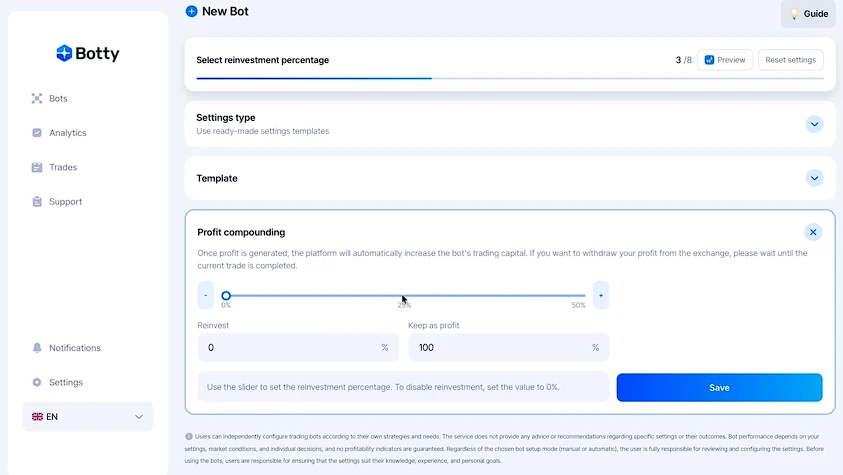
A trading template on Botty Bot is a pre-configured set of parameters that defines how a bot will behave. It determines which asset the bot trades, how the grid of orders is structured, how much of the available budget is deployed per order, what price levels trigger new positions, and at what point the bot closes a series of orders to lock in profit.
Users can launch a bot using one of Botty’s ready-made templates without needing to configure any of these parameters themselves. The templates have been developed and refined by the platform’s founding team over years of real-money trading and validated through backtests covering multiple years of historical market data.
Alternatively, users with trading experience can customize templates to suit their own preferences, adjusting parameters such as the grid range, order distribution, and profit-taking thresholds. This flexibility makes the platform usable both by complete beginners and by experienced traders who want granular control.
The key distinction between template categories, however, is not about customization — it is about the underlying market mechanism each type uses and the risk characteristics that come with it.

Spot Trading Templates: Owning the Asset
A spot bot buys and holds the actual cryptocurrency asset. When a Botty spot template is running on ETH, for example, the bot is purchasing real Ethereum on the user’s exchange account. The profit mechanism is straightforward: the bot buys ETH at lower prices and sells it at slightly higher prices, targeting a small percentage gain per closed trade — typically around 0.8% — across a high volume of transactions.
The core defensive feature of spot trading is that there is no liquidation. If the price of ETH drops significantly after the bot has accumulated a position, the bot simply holds the asset. The user still owns the ETH. This is conceptually similar to buying a property: if market prices decline after purchase, you still own the property. Its value on paper may have decreased, but the asset itself has not disappeared.
This characteristic gives spot bots a meaningful safety floor. In an extended market downturn — a bear cycle that lasts one, two, or even three years — a spot bot user is not at risk of forced liquidation. The bot may sit in an unrealized loss for an extended period, but the underlying asset remains on the account and can be utilized in other ways. For instance, assets held in a spot bot position can potentially be redirected to DeFi instruments such as staking or liquidity pools during periods when the bot is not actively trading, generating additional yield while waiting for market conditions to improve.
The trade-off for this security is return potential. Spot bots, by their nature, operate without leverage. Their gains are derived entirely from the actual price movement of the asset and the volume of trades executed. In favorable market conditions — a sustained bull market with consistent volatility — spot templates have historically demonstrated monthly returns of approximately 3%. This is meaningful on a compounding basis over time, but it is lower than what well-configured futures templates can generate under similar conditions.
Spot templates are well suited to users who prioritize capital preservation, are new to automated trading, or are uncertain about their ability to monitor market cycles closely. They are also a natural choice for users who want exposure to core crypto assets and are comfortable with the idea of holding through temporary drawdowns.

Futures Trading Templates: Trading the Contract
A futures bot does not purchase the underlying asset. Instead, it trades a contract — a financial instrument that represents a bet on the future price of an asset. When a Botty futures template is running on BTC, the bot is opening and closing leveraged positions on Bitcoin’s price, not accumulating actual Bitcoin.
The key difference from spot trading is leverage. Botty’s futures templates use leverage, which means the bot controls a position size larger than the capital actually deployed. With 10x leverage, for example, $1,000 of capital controls a $10,000 position. This amplification increases both the potential profit per trade and the potential loss.
In practice, this means futures templates can generate substantially higher returns than spot templates under favorable conditions. Historical performance data from Botty’s futures templates during bull market periods has shown monthly returns in the range of 10% — roughly three times the historical spot equivalent. On an annualized basis with reinvestment, these figures become significant.
However, futures trading introduces a risk that spot trading does not have: liquidation. Liquidation occurs when the price moves so far against an open position that the exchange’s margin requirements are no longer met. At that point, the position is forcibly closed at a loss, and the capital allocated to it is gone.
Botty’s futures templates are specifically designed to push the liquidation threshold as far as possible from likely price levels. The grid of orders is structured so that even a major price decline — for BTC, the templates are calibrated with a liquidation threshold approximately 34% below the current price at entry — should trigger multiple profitable closes on the way down through partial recoveries, long before liquidation becomes a realistic scenario. For ETH, the equivalent buffer is approximately 45%.
But the critical word is ‘should.’ In an extreme scenario — a sustained, near-vertical price decline without any meaningful upward corrections — a futures bot could theoretically be liquidated. The platform is clear on this point: liquidation risk is managed, not eliminated. This is why the capital reserve model matters so much for futures users.

What Is Leverage and Why It Changes Everything
For users who are unfamiliar with futures trading, leverage deserves a more detailed explanation, because it is the central variable that separates the risk profile of spot and futures templates.
Think of leverage as borrowing power. When you trade with 10x leverage, you are essentially borrowing 9 units of value for every 1 unit you actually own. If the trade goes in your favor, your gains are calculated on the full 10 units. If it goes against you, your losses are also calculated on the full 10 units — but you only have 1 unit as a buffer.
A 10% move against your position with 10x leverage results in a 100% loss of the margin you put in. This is liquidation. Without leverage, a 10% adverse move results in a 10% unrealized loss — uncomfortable, but recoverable.
Botty limits leverage on its templates to a maximum of 10x, which is considerably lower than the maximum leverage some exchanges offer. This is a deliberate design choice. The platform’s philosophy prioritizes sustainable, long-term performance over maximum short-term gain. High leverage ratios dramatically increase the likelihood of liquidation, which defeats the purpose of building a systematic trading strategy.
Even at 10x, however, the importance of keeping an adequate capital reserve cannot be overstated. The platform’s standard recommendation is to deploy no more than 50% of the capital allocated to futures bots into active positions, with the remaining 50% sitting as an undeployed reserve on the same exchange account. This reserve serves as a buffer that pushes the liquidation price further down, substantially reducing the risk that any realistic market move reaches it.

All-Season Templates: Stability Across Market Phases
The third category — all-season templates — occupies a middle ground between the capital preservation of spot bots and the higher-return potential of futures bots. These templates are designed to perform reasonably well regardless of whether the market is in a bull phase, a bear phase, or a sideways consolidation.
The trade-off is explicit: all-season templates historically generate lower returns than bull-market-specific templates during a strong uptrend, but they are far less vulnerable to the kind of extended losses that can occur if a directional template is deployed at the wrong point in the market cycle.
The practical value of all-season templates is significant for users who do not have the market knowledge or monitoring capacity to identify cycle transitions. Crypto markets tend to move in multi-year cycles — a sustained uptrend followed by a prolonged downtrend, then recovery. Identifying the peak of a bull cycle and switching strategies at the right moment requires both experience and active attention. Many users do not have both.
For those users, an all-season template provides a lower-maintenance option: a strategy that does not require precise timing, does not demand that the user identify market phase shifts, and does not expose them to the specific risks of running a bull-market template into a bear cycle. The potential upside is lower, but so is the complexity of managing it correctly.

Bull and Bear Market Templates: For Experienced Users Only
Botty also offers templates specifically calibrated for bull and bear market conditions. These are designed to maximize performance during a particular market phase — a bull template optimized for accumulating and profiting during sustained price appreciation, a bear template configured for the specific dynamics of extended downtrends.
The historical performance of these templates during their intended market phase is substantially higher than all-season alternatives. The 2021 market cycle provides a useful reference point: the market spent approximately two years in a broad uptrend, during which a well-configured bull template would have had continuous productive conditions. Users who deployed appropriate templates during that period and exited near the cycle peak would have captured significant returns.
The critical word, again, is ‘exited.’ A bull template running into a bear market — as occurred after the peak of the 2021 cycle — can result in the bot accumulating an increasingly deep position as prices fall, with no prospect of recovery until the market eventually turns around again. In the 2022-2023 bear market, that wait was approximately two years. A user who did not switch strategies at the cycle peak could have found their capital locked in an unrealized loss for that entire period. For futures templates in a bear market, the risk extends further — to potential liquidation if the decline is severe enough.
Botty is explicit in recommending that bull and bear market templates should only be used by traders who have a solid understanding of market cycles and the discipline to exit when conditions change. The platform notes that no one can predict with certainty where the peak or trough of a cycle is — but experienced market participants can identify late-cycle signals with reasonable reliability. For everyone else, the all-season templates are the more prudent choice.
How Backtesting Helps You Choose
One of the most practical tools available to Botty users before deploying any real capital is the backtesting function. A backtest runs a template’s configuration against historical price data to show how it would have performed over a specified period — one year, two years, five years.
This is not a guarantee of future results. Markets change, and past conditions do not repeat exactly. But backtesting provides a concrete basis for understanding how a strategy behaves under different conditions. A user considering a futures template can see how it would have fared through the 2022 bear market, how deep the drawdowns were, and whether the strategy recovered — and over what timeframe.
Botty encourages all users to review backtests before deploying real capital. The platform’s ready-made templates include this historical data, making it accessible without requiring any technical knowledge of backtesting methodology. Users can compare the historical performance profiles of different templates and make an informed choice based on their own risk tolerance and expectations.
The backtesting function also serves a broader educational purpose. By working through the historical performance of a strategy, users develop an intuitive understanding of how the bot behaves in different market phases — which in turn makes them better equipped to make decisions about when to adjust, pause, or redirect their bots as market conditions evolve.

Capital Allocation: The 80/20 Framework
For users who want to run both spot and futures bots simultaneously — which many Botty users do — the platform recommends a portfolio allocation of approximately 80% spot and 20% futures. This balance reflects the different risk and return profiles of each type.
The spot allocation provides the portfolio’s stability. It is the portion that will not liquidate, will hold real assets through market downturns, and will generate steady, lower-risk returns over time. The futures allocation provides the portfolio’s upside potential, with higher return expectations during favorable conditions but a contained exposure to liquidation risk.
This 80/20 framework is not a rigid rule — experienced users may choose different allocations based on their own assessment of market conditions and risk tolerance. But it serves as a sensible default for users who are building a diversified automated trading approach for the first time.
Within the futures allocation, the 50% active / 50% reserve model applies. Of the 20% of total portfolio capital allocated to futures, no more than half should be in active bot positions at any given time, with the remainder held as a capital reserve on the exchange to support the liquidation buffer.

Which Template Is Right for You?
The right template depends on three factors: your experience level, your capital management capacity, and your market knowledge.
If you are new to automated trading, have no experience reading market cycles, and want a low-maintenance setup that does not require active monitoring, spot templates or all-season templates are the appropriate starting point. They do not offer the highest potential returns, but they also do not expose you to liquidation risk or require you to make timing decisions about market phases.
If you have experience in crypto markets, understand the concept of leverage and liquidation, and have sufficient capital to maintain the recommended reserve ratios, futures templates may be worth exploring. The historical return potential is higher, but the management requirements are also higher. You should review backtests carefully, understand where the liquidation threshold sits relative to current prices, and have a plan for what you will do if market conditions shift significantly.
If you want exposure to directional market performance — capturing the upside of a bull cycle more aggressively — bull market templates may be appropriate, but only if you have the market awareness to recognize when conditions are changing. Running a bull template into a bear market is one of the most common and costly mistakes in algorithmic trading.
For most users, the practical recommendation is to start with a spot or all-season template, run it with real capital for at least a few months to observe how it behaves across different short-term market conditions, and then make a more informed decision about whether and how to incorporate futures templates into the portfolio.