

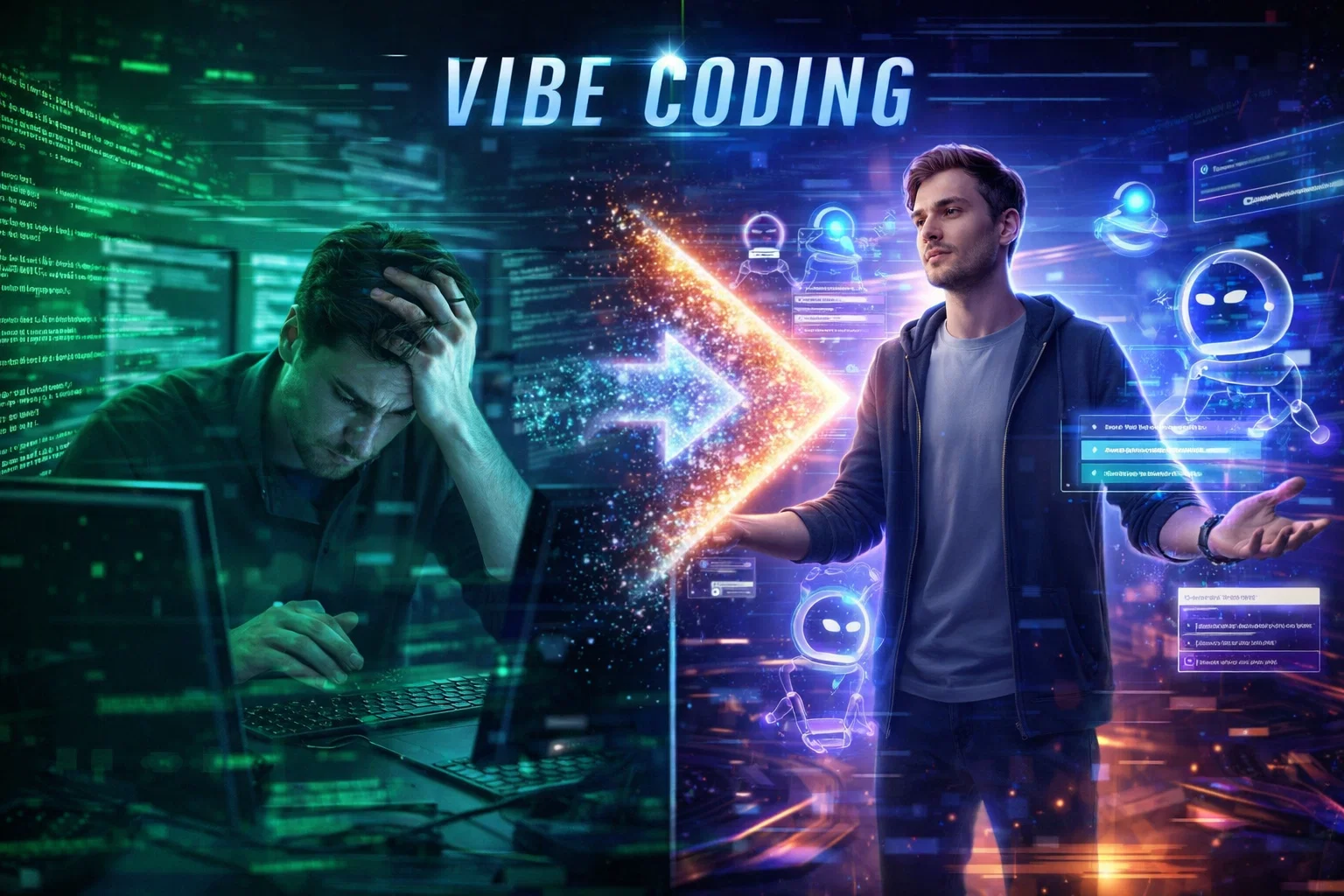
In February 2025, Andrej Karpathy—AI researcher and former Tesla AI Director—coined a term that would send shockwaves through the software development world: “vibe coding.”
What started as a “shower of thoughts throwaway tweet” quickly evolved into a movement that is fundamentally reshaping how we build software.
But Karpathy didn’t stop there. Just one year later, he declared vibe coding “passé,” introducing “agentic engineering” as the next evolution.
This rapid progression signals something profound: we’re not just witnessing a new tool or methodology—we’re experiencing a paradigm shift in human-computer collaboration.
This article explores how vibe coding is shaping the future of software development, why the transition to agentic engineering matters, and what organizations must do to stay competitive in this new landscape.
Table of Contents
What Is Vibe Coding? From Concept to Mainstream
The Original Definition
Vibe coding describes a software development practice where the primary role shifts from writing code line-by-line to guiding an AI assistant through natural language prompts. As Karpathy originally framed it, this approach involves “fully giving in to the vibes, embracing exponentials, and forgetting that the code even exists.”
The concept builds on Karpathy’s 2023 observation that “the hottest new programming language is English”—highlighting how large language models (LLMs) have transformed natural language into a viable programming interface.
Two Approaches to Vibe Coding
According to Google Cloud’s analysis, vibe coding manifests in two distinct forms:
- “Pure” Vibe Coding: Fully trusting AI output for rapid ideation, prototypes, and “throwaway weekend projects” where speed trumps precision.
- Responsible AI-Assisted Development: AI acts as a “pair programmer” while humans review, test, and maintain ownership of the final product—the model gaining traction in professional environments.
The Market Explosion: By the Numbers
The vibe coding market isn’t just growing—it’s exploding. According to Congruence Market Insights, the sector is projected to grow from $3.89 billion in 2024 to $36.97 billion by 2032, representing a massive expansion driven by enterprise adoption and democratization pressures.
Key Growth Drivers
| Driver | Impact |
|---|---|
| No-code democratization | ~45% of growth |
| Reduced development time | ~40% efficiency gains |
| Enterprise AI adoption | ~35% of organizations |
| Prototype speed improvement | 50% faster by 2028 |
By 2024, over 30% of early-stage startups globally reported using vibe coding to build MVPs in under a week, while 25% of SMBs in North America adopted these frameworks for internal operations.
The Evolution: From Vibe Coding to Agentic Engineering
Why Vibe Coding Became “Passé”
In February 2026, Karpathy announced that LLMs had become sophisticated enough to require a new term. “Today (1 year later), programming via LLM agents is increasingly becoming a default workflow for professionals, except with more oversight and scrutiny,” he explained.
The goal of this new era? “Claim the leverage from the use of agents but without any compromise on the quality of the software.”
What Is Agentic Engineering?
Karpathy defines agentic engineering as:
“‘Agentic’ because the new default is that you are not writing the code directly 99% of the time, you are orchestrating agents who do and acting as oversight—’engineering’ to emphasize that there is an art & science and expertise to it.”
This shift represents maturation. While vibe coding emphasized surrendering control to “the vibes,” agentic engineering recognizes that professional software development requires deliberate orchestration, quality standards, and human expertise—just expressed through agent management rather than manual coding.
How Vibe Coding (and Agentic Engineering) Are Reshaping Development
1. The Democratization of Software Creation
Perhaps the most profound impact is the removal of technical barriers. Individuals without programming backgrounds can now create functional applications by describing their needs in plain language.
This democratization enables:
- Domain experts to build solutions directly without technical intermediaries
- Small businesses to access custom software without hiring specialized developers
- Rapid innovation as ideas move from concept to prototype in hours rather than weeks
2. Hybrid Workflows: The Convergence Prediction
The future isn’t vibe coding or traditional coding—it’s strategic convergence. Bubble.io’s 2025 State of Visual Development predicts that by 2027, the distinction between “visual development” and “vibe coding” will blur entirely.
The winning formula: Hybrid platforms offering both AI-powered generation and visual editing—giving builders speed and control.
3. New Professional Roles
As the industry evolves, we’re seeing the emergence of new specializations:
- AI Orchestration Engineers: Professionals who specialize in managing multi-agent systems
- Prompt Architects: Engineers who design sophisticated prompt chains for complex applications
- AI Quality Assurance Specialists: Experts in validating and securing AI-generated code
4. Enterprise-Grade Evolution
For vibe coding to succeed in production environments, several critical capabilities are emerging:
- Transparency tools showing exactly what code was generated
- Built-in debugging capabilities for when AI makes mistakes
- Visual editing post-generation to avoid re-prompting
- Production infrastructure including hosting, scaling, and security
- Governance frameworks with prompt logging and audit trails (already adopted by 28% of pilot deployments in 2025)
The Technology Stack: Tools Leading the Revolution
The vibe coding ecosystem has matured rapidly, with several platforms dominating the landscape:Table
| Platform | Strength | Best For |
|---|---|---|
| Cursor | AI-native IDE workflows | Professional developers seeking deep control |
| Replit | Collaborative environments | Teams and educational projects |
| GitHub Copilot | Enterprise DevOps integration | Large organizations with existing workflows |
| Lovable | Rapid prototyping | Startups and MVPs |
| Windsurf | Multi-agent orchestration | Complex, multi-step applications |
The top five platforms—Cursor, Replit, GitHub Copilot, Tabnine, and Amazon CodeWhisperer—currently command approximately 60% of market deployments.
Practical Applications: Where Vibe Coding Excels Today
Immediate Use Cases
Based on current adoption patterns, vibe coding delivers maximum value in:
- Rapid Prototyping & MVPs: Validating product-market fit without heavy technical investment
- Internal Tools: Building dashboards, automations, and workflow utilities
- UI Scaffolding: Generating front-end components and user flows
- Educational Projects: Accelerating learning through immediate feedback
- Greenfield Projects: New applications without legacy constraints
Real-World Impact
In 2025, a Swedish startup used vibe coding toolkits to cut internal tool development time by 60% across 10 teams.
Meanwhile, Replit Teams Pro (launched March 2024) enabled 500+ enterprise users to achieve 33% faster project completion through collaborative AI coding workflows.
The Critical Limitations: When to Avoid Vibe Coding
Despite its promise, vibe coding is not universally applicable. Professional developers emphasize that traditional coding remains essential for:
- Mission-critical systems where failures pose safety or financial risks
- Regulated industries (healthcare, finance, aerospace) requiring compliance and audit trails
- High-performance applications (games, real-time systems) demanding optimization
- Legacy system maintenance requiring deep architectural understanding
- Security-critical applications where AI-generated vulnerabilities could be catastrophic
The golden rule: Vibe coding accelerates creation; traditional coding ensures reliability. The most effective teams use both strategically.
The Future Landscape: 2025-2032
Near-Term Developments (2025-2026)
- Multimodal prompt agents: 15% of new platforms now support voice + sketch + text fusion for code generation
- Self-healing code agents: Early systems already resolve ~12% of prompt failures autonomously
- Federated development models: Distributed AI coding across organizational boundaries
Medium-Term Evolution (2027-2030)
- Convergence of categories: Visual development and vibe coding merge into unified platforms
- Enterprise standardization: Agentic engineering becomes the default workflow for 70%+ of new software projects
- Regulatory frameworks: Code audit compliance and ethical AI mandates shape tool development
Long-Term Vision (2030-2032)
- Autonomous software engineering: AI agents handling complete development lifecycles with minimal human oversight
- Natural language as universal interface: Programming syntax becomes specialized knowledge, like assembly language today
- $36.97 billion market maturity: Vibe coding/agentic engineering becomes standard infrastructure
Strategic Recommendations for Organizations
For Startups and SMBs
Adopt aggressively—the barrier to entry for software creation has never been lower. Use vibe coding to:
- Validate ideas before investing in technical teams
- Build internal tools that previously required expensive contractors
- Accelerate time-to-market for MVPs
For Enterprise Organizations
Implement governance-first:
- Establish prompt management and audit trail systems
- Create clear policies for AI-generated code review
- Invest in hybrid platforms that offer both AI generation and traditional control
- Train existing developers in agentic engineering principles
For Developers
Evolve your skillset:
- Master prompt engineering and AI orchestration
- Develop expertise in code review and AI quality assurance
- Focus on system architecture and high-level design (areas where human judgment remains superior)
- Maintain traditional coding proficiency for critical systems
Conclusion: The Human Element Remains Central
Vibe coding—and its evolution into agentic engineering—doesn’t eliminate the need for human developers. Instead, it elevates the role. Developers transition from syntax implementers to solution architects, from code typists to AI orchestrators.
As one engineer summarized in a recent LinkedIn discussion: “We’re not replacing traditional coding. We’re changing how we start. With vibe coding, we describe the end state, and AI fills in the scaffolding. Then, our expertise makes it production-ready.”
The future belongs to those who can harness the speed and accessibility of AI-generated code while maintaining the rigor, security, and scalability that professional software demands. The question is no longer whether vibe coding will shape the future—it already is. The question is whether your organization will shape that future or be shaped by it.
Ready to explore vibe coding? Start with responsible AI-assisted development: choose a platform, experiment with internal tools, and establish governance frameworks before scaling to production systems. The revolution is here—participate thoughtfully.
