

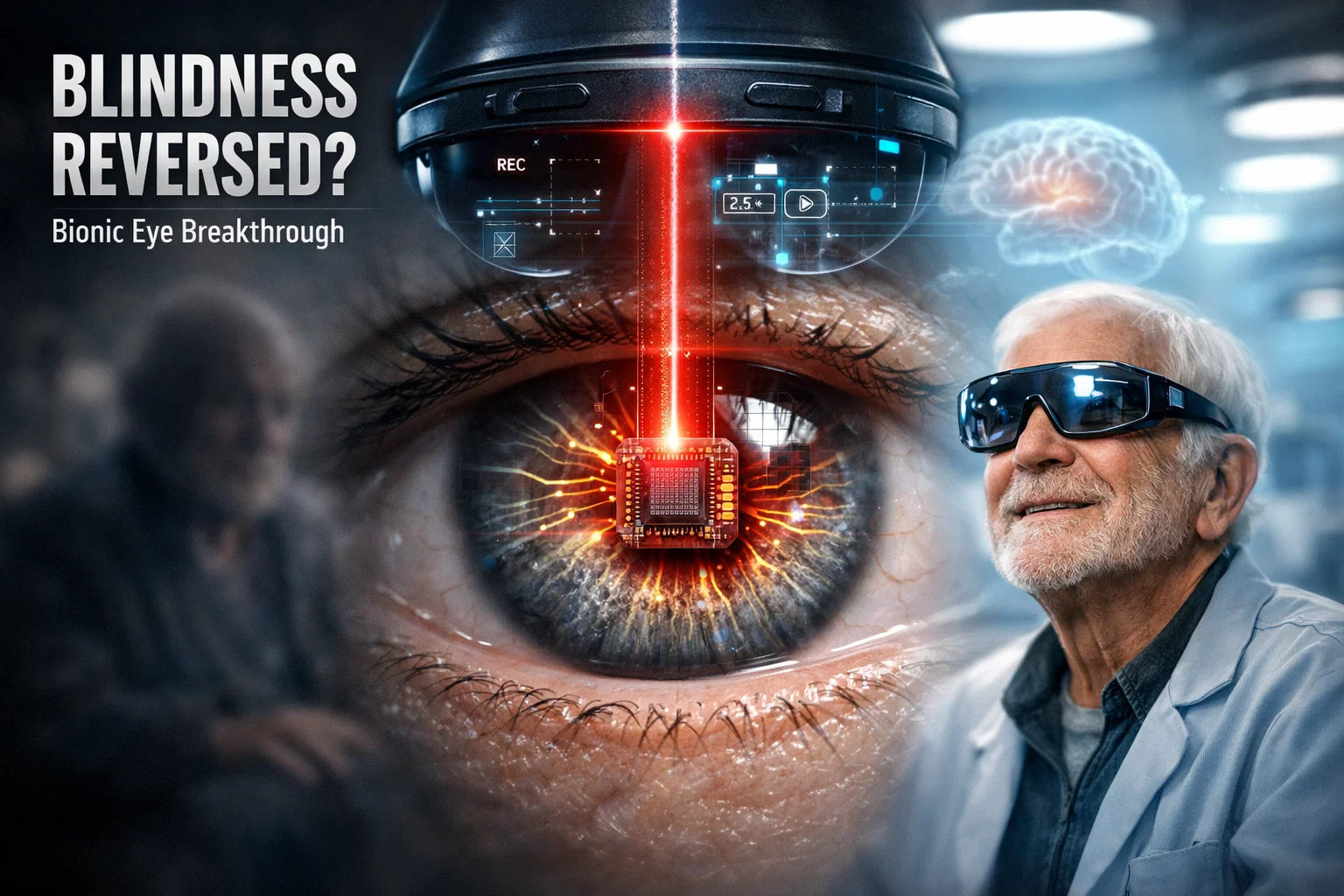
For decades, the most honest thing a retinal specialist could tell a patient with advanced macular degeneration was this: “We can slow it down.” That was the ceiling. Manage the decline, preserve what remains, and hope that gene therapy eventually catches up. The clinical playbook was fundamentally defensive, and the industry largely accepted that framework without question.
I think that acceptance was a mistake — and the data from 2025 and early 2026 is proving it.
We are now standing at an inflection point that the field has been building toward for over a decade. Unlike conventional therapies that attempt to slow disease progression, PRIMA directly restores lost functional vision in GA patients. ¹ That is not marketing language. That is a peer-reviewed conclusion published in the New England Journal of Medicine. The conversation has fundamentally changed, and anyone still framing visual prosthetics as a niche curiosity is misreading the room.
Table of Contents
Surgeons Are Now Implanting Vision, Not Just Protecting What Is Left
There is a critical distinction between the two, and it matters enormously for how we think about patients, investment, and clinical development timelines.
The PRIMA system restored central vision and led to a significant improvement in visual acuity from baseline to month 12 — and no therapies to restore vision in such persons currently exist. ¹ Read that second clause again. No therapies. Until now.
The PRIMA device, comprised of a small light-powered retinal implant and a special pair of glasses that provide wireless power and data to the implant, targets patients suffering from geographic atrophy due to age-related macular degeneration — a leading cause of blindness affecting over 5 million people worldwide. ² The PRIMA implant is a 2×2mm wide and 30μm thick crystalline silicon array comprising 378 photovoltaic pixels, each 100μm in size. ¹ A frame-mounted camera on the PRIMA glasses captures images, and projects them after processing onto the implant using near-infrared light. The implant’s pixels convert near-infrared light into electric pulses to stimulate retinal bipolar cells, restoring the flow of visual information. ¹
There are no cables, no internal batteries, and no external power packs clipped to a belt. The simplicity of the engineering is, in my view, one of its most underappreciated assets — particularly in the context of patient compliance and long-term adoption.
Reading Off an Eye Chart Is Not the Same as Getting Your Life Back
The results from the PRIMAvera trial deserve careful reading, because the raw numbers are both genuinely impressive and appropriately sobering.
The results demonstrated a mean improvement of 25.5 letters — equivalent to more than five lines — on the ETDRS letter chart, with 84% of patients regaining the ability to read letters, numbers, and words. ¹ In practice, 27 out of 32 participants reported being able to read letters, words, and numbers at home. ² High-tech glasses allowed them to adjust contrast and brightness and magnify objects up to 12 times, enabling participants to read smaller fonts than the implant’s native pixel resolution would predict. ²
That last point is critical and often gets lost in the headline figures. The system is not just a passive chip. It is a chip-plus-software platform with active digital enhancement. The glasses are doing meaningful computational work, which means the effective visual performance is better than the raw electrode count would suggest.
Now, the honest part. A total of 26 serious adverse events occurred in 19 participants, with 81% of these events occurring within 2 months after surgery, of which 95% resolved within 2 months after onset. ¹ Half of all participants experienced a serious adverse event. The industry should not minimize that figure. That said, the Data Safety Monitoring Board recommended PRIMA for European market approval, finding that the benefits to patients outweighed the risk of the implantation surgery. ² The risk profile is real, but contextually, it is not disqualifying — especially for a patient population that currently has no alternative.
Retinal Chips and Brain Implants Solve Different Problems. The Industry Needs Both.
One of the most persistent misunderstandings I encounter is the framing of retinal implants versus cortical implants as competing approaches. They are not. They are solutions to different problems, and the industry needs both tracks to mature simultaneously.
The PRIMA system works because the optic nerve is intact. PRIMA combats photoreceptor loss with its wireless subretinal implant that operates as an array of artificial photoreceptors, stimulating the remaining cells to carry the visual signal to the brain. ¹ If the pathway from eye to brain is functional, a retinal chip is the most minimally invasive, biologically congruent solution available.
But for patients who have no eyes, no optic nerve, or whose retinal infrastructure is entirely gone, you need to go directly to the brain. That is where cortical implants become not just relevant, but irreplaceable.
Neuralink’s Blindsight works by sending electrical impulses directly into a volunteer’s visual cortex, producing spots of light called phosphenes. If there are enough spots, they can be organized into a simple, pixelated form of vision. Because it doesn’t rely on eyes or optic nerves, the implant is aimed at people with complete blindness — as long as the visual cortex is intact, the system could work. ³
The FDA’s Breakthrough Device Designation for Blindsight in September 2024 was a meaningful regulatory signal. ³ The designation does not mean that Blindsight is yet considered safe or effective, but that technologies in the program have potential to improve the current standard of care — and are novel compared to what is available on the market. That is an important distinction. Breakthrough designation accelerates the review process; it does not shortcut the evidence bar.
The Bigger Risk Is Not the Surgery. It Is the Device Outliving Its Maker.
Short-term trial results get the headlines. Six-year durability data does not — and that is a problem.
Here is why it matters: the most cautionary tale in this field is Second Sight Medical Products, which manufactured the Argus II retinal implant. When the company approached bankruptcy in 2020, patients were left with hardware in their eyes and no technical support, no software updates, and no recourse. Ethics boards noticed. The industry should have been asking about long-term device sustainability from the beginning.
From what I have seen, the most undervalued dataset published in early 2026 is Cortigent’s 6-year stability results for the Orion cortical implant. Ninety-six percent of implanted electrodes remained functional after six years of continuous operation. All six trial participants showed measurable improvement in spatial orientation tasks compared to when the device was inactive. ⁵ Six years. That is not a trial result — that is a proof of concept for long-term viability.
In recent years, other companies developing artificial vision prosthetics have reached clinical research trials or beyond, only to struggle financially, leaving patients without support. Some of these technologies live on with new backing: Second Sight’s Orion cortical implant project is now in a clinical trial with Cortigent, and Pixium Vision’s Prima system is now owned by Science Corporation, with ex-Neuralink founder Max Hodak at the helm. ²
The consolidation is notable. Institutional memory is being preserved, which is genuinely good for patients. But the broader lesson — that hardware longevity and company longevity are both part of the patient safety equation — needs to be built into regulatory frameworks more systematically going forward.
The Implant Switches On in Hours. The Brain Takes Months to Understand It.
There is a widespread misconception that visual prosthetics work like switching on a light. Plug in the device and the patient sees. That is not how any of this works, and the failure to communicate this clearly has created unrealistic public expectations that ultimately harm the field when patients report “limited” initial results.
The brain, particularly the visual cortex in adults, requires months of structured rehabilitation to learn how to interpret new electrical input patterns. Blindsight works by sending electrical impulses into the visual cortex, producing spots of light called phosphenes. If there are enough spots, they can be organized into a simple, pixelated form of vision. ³ The operative phrase is “can be organized” — that organization is a learned cognitive process, not an automatic one.
The 3-to-6-month rehabilitation window documented across multiple trials is not a limitation of the technology. ³ It is a feature of the biological system the technology is interfacing with. A device that produces phosphenes after surgery and produces navigational competence after training is working exactly as designed. Framing the gap between the two as a failure is both clinically inaccurate and damaging to patient morale.
It is also worth noting that the Illinois Tech ICVP patient, after two years of active use, reported an enhanced ability to independently locate doorways and navigate hallways — outcomes that only became meaningful after sustained training, not immediately after implantation. ⁶ Setting calibrated expectations is not pessimism. It is clinical responsibility.
A $150,000 Bionic Eye Is Not a Solution. It Is a Starting Point Nobody Can Afford.
From what I have observed across this field, the engineering problems, while formidable, are being solved. The access problem is not.
In Europe, Science Corporation has applied for regulatory approval and hopes to have PRIMA available to patients in the near future. In the US, an FDA approval process is underway. ² When those approvals land, the device is projected to cost upwards of $150,000. That price point will create what some researchers are already calling a “Vision Divide” — a world in which technological sight restoration is available to those with premium insurance coverage or significant personal wealth, while the majority of the 5 million people living with geographic atrophy globally remain untreated.
PRIMA restored functional central vision to patients suffering from geographic atrophy due to AMD, a leading cause of blindness affecting more than 5 million people worldwide. ¹ Five million people is a large and underserved addressable population. The clinical case for coverage is strong. The economic and political infrastructure to support that coverage does not yet exist.
This is not a technology problem. It is a health policy problem. And the industry needs to engage it directly rather than treating it as someone else’s responsibility.
The Next Generation of the Human Eye Is Already Being Engineered
The honest answer is that we are at the end of the beginning. The PRIMAvera data published in the NEJM is a landmark. ¹ Cortigent’s 6-year stability results are a landmark. ⁵ The FDA’s Breakthrough Device Designation for Blindsight is a landmark. ³ Together, they establish that functional vision restoration is not theoretical — it is clinical.
Unlike conventional or experimental therapies that attempt to slow disease progression, PRIMA directly restores lost functional vision, offering patients new independence and quality of life. ² Science Corporation is already developing the next version of the implant and glasses, which will optimize visual performance further with digital image processing and streamlined ergonomics to bring this technology to more patients. ²
The arc from here runs in two directions simultaneously. On the retinal side, next-generation pixel density improvements and enhanced on-chip signal processing will push effective acuity closer to functional independence thresholds. On the cortical side, higher electrode counts — Neuralink’s Blindsight, with its significantly higher electrode density than predecessor devices, offers the potential for higher resolution visual perception than earlier approaches ³ — will close the gap between the rudimentary phosphene patterns of today and genuinely structured visual output.
What I think most people underestimate is the compounding effect of software. The hardware is implanted once. The software improves continuously. A patient implanted today with PRIMA’s current chip could have meaningfully better functional vision in three years simply through firmware and glasses updates — without a second surgery. That is a very different value proposition than previous generations of prosthetic devices offered.
The ceiling on this technology is not yet visible. What is visible, right now, in peer-reviewed data, in regulatory filings, and in the lived experience of patients reading pages in a book for the first time — is that the floor has been raised permanently.
Blindness is no longer a one-way street. The field should start planning accordingly.
References
1. Holz, F. G., Palanker, D., et al. (2025). “Subretinal Photovoltaic Implant to Restore Vision in Geographic Atrophy.” New England Journal of Medicine. DOI: 10.1056/NEJMoa2501396.
2. Science Corporation. (October 2024 / January 2026). PRIMAvera Clinical Trial: Final 12-Month Outcomes. Science Corporation Official Publications.
3. U.S. Food and Drug Administration (FDA). (September 2024). Breakthrough Device Designation: Neuralink Blindsight. FDA Official Designation Records.
4. Allen, P., et al. (February 2025). “Surgical Stability and Safety of Suprachoroidal Retinal Prosthesis.” Ophthalmology Science.
5. Cortigent / Vivani Medical. (January 29, 2026). 6-Year Early Feasibility Study Results for the Orion Visual Cortical Prosthesis System. Presented at the North American Neuromodulation Society (NANS) Annual Meeting 2026.
6. Illinois Institute of Technology (IIT). (April 2024). Two-Year Milestone for the Intracortical Visual Prosthesis (ICVP) Project. IIT Official Research Communications.
