

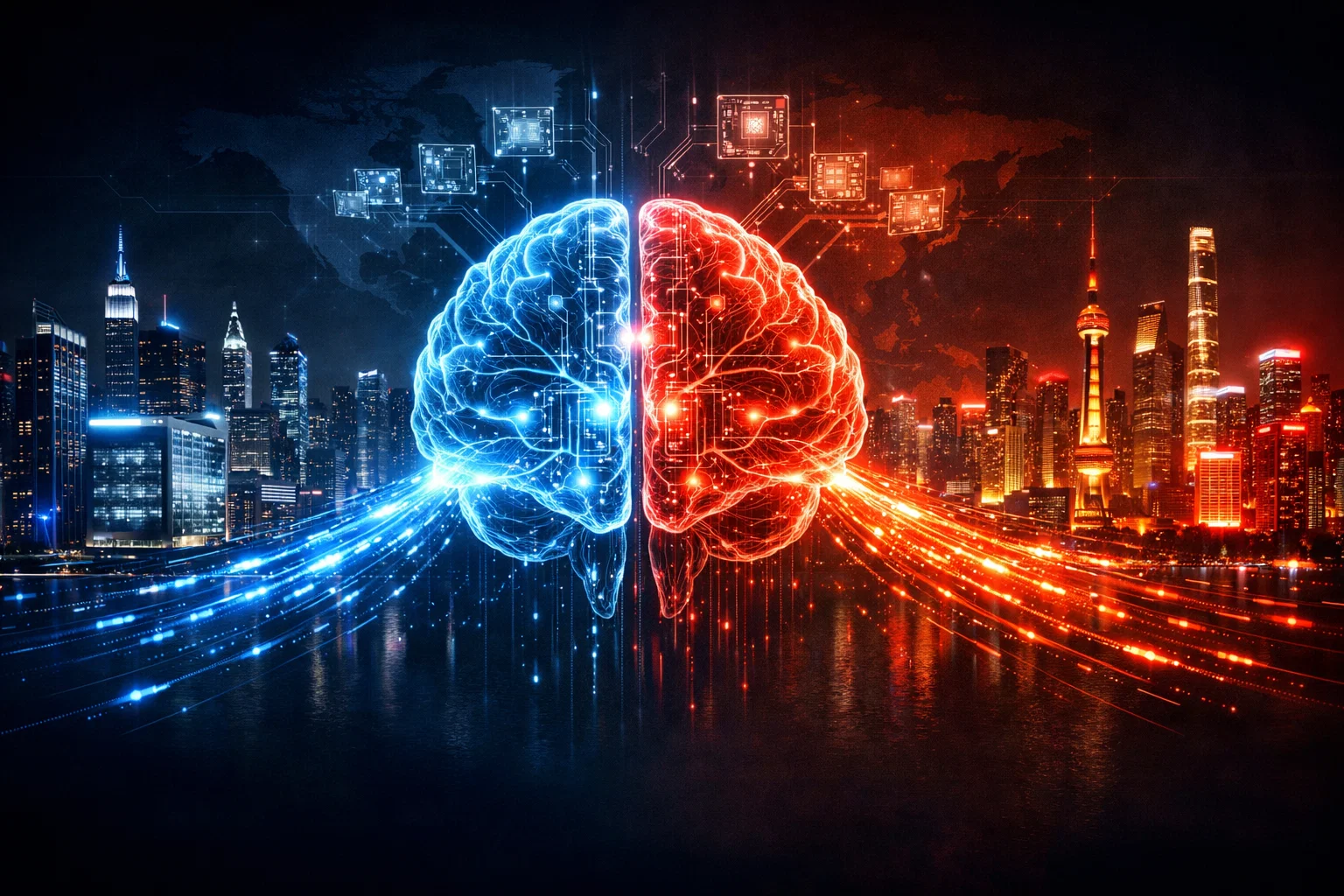
Most people think the AI race between the United States and China is a simple contest: whoever builds the smartest AI wins.
I think that idea misses the point entirely.
From what I’ve seen, this isn’t just a technology competition — it’s a systems competition. The real battle is about infrastructure, talent, chips, standards, and influence. AI is just the surface layer. Underneath it is a deeper struggle over who will shape the digital world for the next 30 years.
The narrative often focuses on models — GPT vs Chinese LLMs — but the real story is about ecosystems. And that’s where things are getting interesting.
Table of Contents
This Isn’t Really an AI Race — It’s an Infrastructure Race
The public conversation is obsessed with models. Every few months, a new model comes out and headlines declare a winner. But models are temporary. Infrastructure is permanent.
The United States still dominates the AI stack where it matters most: advanced chips, cloud infrastructure, and foundational research. Companies like NVIDIA and OpenAI sit at critical choke points in the global AI ecosystem.
China understands this weakness, which is why it’s investing heavily in domestic chips and compute. Companies like Huawei are not just building phones — they’re trying to replace entire supply chains.
From a strategic standpoint, compute is power. The country that controls the infrastructure controls the pace of innovation.
That’s why export controls on chips matter more than model benchmarks.
The Two Countries Are Playing Completely Different Games
One of the biggest misunderstandings is that the U.S. and China are competing using the same strategy.
They’re not.
The U.S. model is decentralized and market-driven. Innovation comes from companies and universities. The government sets guardrails but rarely dictates direction.
China’s approach is coordinated. The government sets priorities, funds projects, and aligns industry around national goals.
This difference creates very different strengths.
The U.S. produces breakthroughs.
China produces scale.
In my experience watching tech ecosystems, breakthroughs get attention — but scale wins markets. China has repeatedly shown it can deploy technology faster and more widely once it decides something matters.
AI may follow the same pattern.
Chips Have Become the New Oil
If there’s one area where the technological war is most visible, it’s semiconductors.
Advanced AI systems depend on specialized chips. Right now, the most powerful AI hardware still comes from the United States. That’s why restrictions on chip exports have become one of Washington’s main tools.
China’s response has been predictable: build its own alternatives.
This is where the rivalry becomes less about AI and more about industrial policy. Semiconductor independence has become a national priority for Beijing, not just a tech goal.
What’s interesting is how quickly this has escalated. A few years ago, chips were a supply chain issue. Now they’re a geopolitical weapon.
That shift alone tells you how important AI has become.
The Real Competition Is Talent
People often talk about data as the fuel of AI. That’s partly true. But talent is still the engine.
The United States still attracts a huge share of the world’s top AI researchers. Its universities and companies remain global magnets for talent.
But that advantage is not guaranteed.
China is investing heavily in domestic education and research. At the same time, visa restrictions and geopolitical tensions are making cross-border collaboration harder.
From what I’ve seen, innovation ecosystems depend heavily on openness. If talent stops flowing, progress slows.
The long-term winner in AI may simply be the country that remains the most attractive place to build.
The Global South Is the Real Battleground
One of the least discussed aspects of the AI rivalry is what’s happening outside the U.S. and China.
Both countries are exporting their technology stacks to developing regions. Cloud platforms, surveillance systems, smart cities, and AI services are becoming tools of influence.
China has been particularly aggressive in infrastructure partnerships and digital projects. The U.S., meanwhile, tends to lead through private companies and platforms.
This matters because technology ecosystems tend to lock in. Once a country builds its systems around one platform, switching becomes difficult.
The future of AI influence may be decided less in Silicon Valley or Beijing — and more in Africa, Southeast Asia, and the Middle East.
The Model Gap Is Smaller Than People Think
There’s a perception that U.S. AI is far ahead and China is trying to catch up.
That’s partially true, but the gap is narrowing.
Chinese labs and companies are producing increasingly capable models. Some recent systems have shown that high performance doesn’t always require massive compute resources.
This is an important shift.
If strong AI models can be built with fewer chips, then export controls become less effective. Constraints often drive innovation, and China has a history of adapting quickly under pressure.
In technology competitions, the underdog often learns efficiency faster than the leader.
Regulation Is Becoming a Competitive Tool
Another shift that doesn’t get enough attention is regulation.
The U.S. and China are not just building AI — they’re shaping how it will be governed.
China has moved faster in implementing national AI rules and oversight. The U.S. has taken a slower, more fragmented approach.
Neither model is clearly superior yet. But governance is becoming part of the competition.
Standards often determine markets. The country that defines the rules can shape how technology evolves globally.
The AI Cold War Is Already Here
People sometimes talk about a future technological cold war. In reality, it’s already happening.
Supply chains are splitting.
Standards are diverging.
Platforms are separating.
The global technology ecosystem is becoming less unified and more regional.
That fragmentation may be one of the most important long-term consequences of the AI race.
Where This Is Heading
I don’t think this competition will produce a single winner.
Instead, we’re likely to see a bifurcated AI world — one ecosystem centered around the United States and another around China.
Some countries will align with one side. Others will try to work with both.
What seems clear is that AI is no longer just a technology industry. It has become a foundation of economic and geopolitical power.
And from what I’ve seen, once technology becomes geopolitical, it stops moving in straight lines.
The AI race between the U.S. and China isn’t just about smarter machines.
It’s about who gets to shape the future.
