

Loading a cylindrical workpiece into a CNC lathe requires more than transferring metal from a tray to a machine. The part must arrive at the chuck in a predictable position, with its axis aligned closely enough to allow reliable clamping. Even small handling errors can interrupt an automated production cycle, particularly when a robot repeatedly loads different workpiece diameters. Three-finger robotic grippers address part of this challenge by centering suitable components during gripping, making them particularly relevant to automated turning operations.
Table of Contents
The Importance of Workpiece Position Before Machining
CNC lathes depend on controlled rotation around a defined spindle axis. Before machining begins, the workpiece must be positioned correctly within the chuck or other holding device. In automated production, the robot is responsible for presenting the component consistently enough for the machine’s workholding system to secure it.
A conventional two-finger gripper can hold cylindrical components effectively, but its gripping geometry may require careful adjustment when workpiece diameters change. Depending on the design, the center of the held object may shift relative to the gripper’s reference position. This can complicate robotic loading when the machine expects components to arrive along a consistent axis.
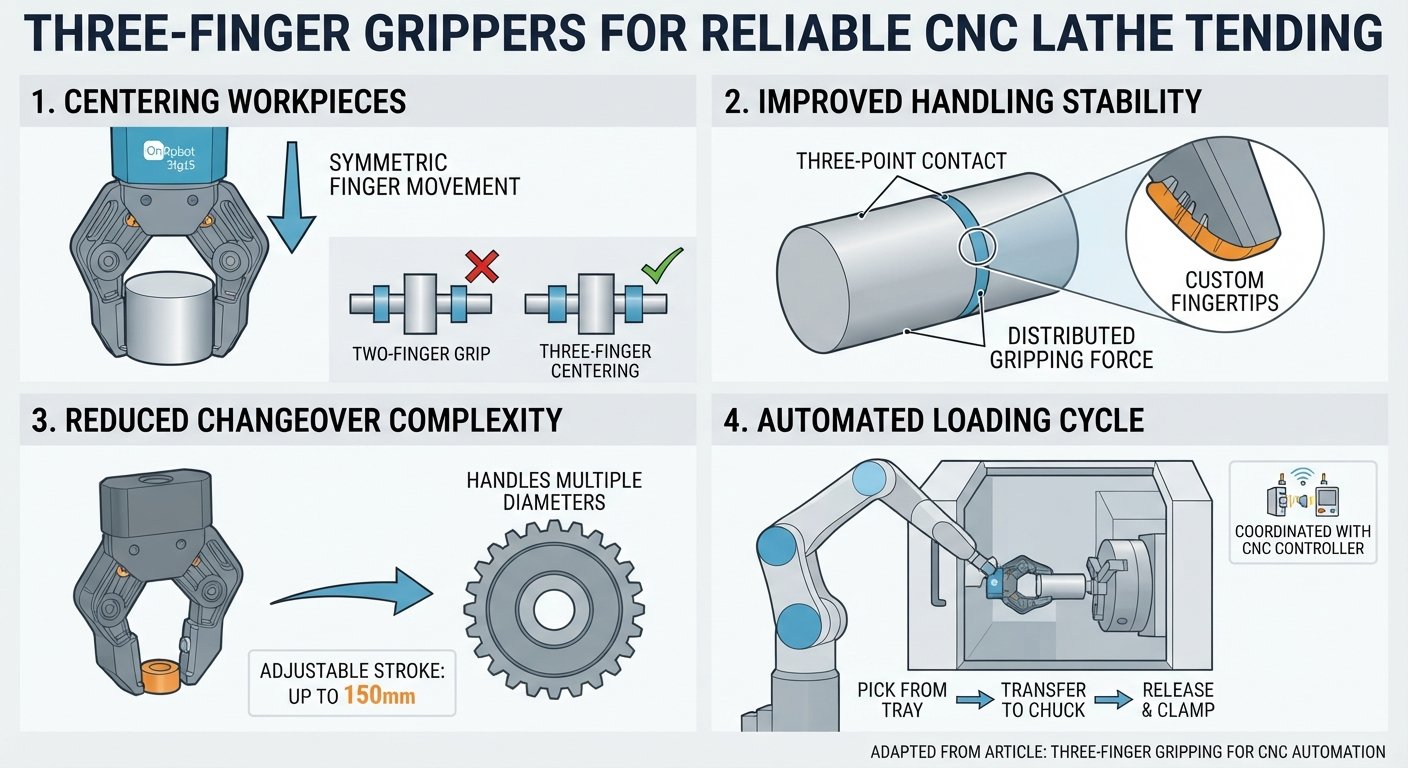
Self-centering three-finger grippers use coordinated finger movement to establish contact around a suitable cylindrical workpiece. When the fingers move symmetrically, the component is brought toward the center of the gripping mechanism. This reduces the need for separate positioning adjustments across certain ranges of workpiece diameters.
Centered gripping does not guarantee perfect alignment with the CNC spindle. Robot positioning accuracy, gripper calibration, finger geometry, and workpiece tolerances all influence the final result. Nevertheless, consistent centering can simplify the relationship between the robot’s programmed position and the workpiece axis.
How Three Contact Points Improve Handling Stability
Three-finger grippers generally distribute contact around the circumference of a cylindrical object. This arrangement can provide stable holding conditions, particularly when the component has a regular geometry and sufficient surface strength. The three contact points help constrain the object’s position during lifting and transportation.
The gripping mechanism may operate through frictional contact with the outside of the component or through engagement with an internal feature. External gripping is common when handling solid cylindrical blanks, while internal gripping can be useful for suitable hollow components. The appropriate method depends on available contact surfaces, workpiece dimensions, and the forces generated during robot movement.
Finger design is particularly important when handling machined surfaces. Excessive gripping force may leave marks on softer metals or damage precision-finished areas, while insufficient force increases the risk of slipping. Custom fingertips can improve contact conditions by matching the workpiece geometry and distributing forces appropriately.
A three-finger arrangement also has limitations. Irregular shapes, asymmetric components, and objects with interrupted gripping surfaces may not center reliably. In these cases, dedicated fixtures or alternative gripping mechanisms can provide better results.
Reducing Changeover Complexity in CNC Cells
CNC machine tending frequently involves handling multiple part sizes using the same robotic installation. A manufacturer may machine several families of bushings, sleeves, or turned components, each with different outside diameters. Changing between these products can require adjustments to gripping equipment and robot positions.
A gripper with a sufficiently large operating range can reduce the need to replace tooling whenever the workpiece diameter changes. This becomes especially valuable in workshops where production runs are relatively short and setup time represents a substantial proportion of available machine hours. However, the actual benefit depends on whether the workpieces share compatible gripping geometries.
The OnRobot 3fg15 is designed for centric gripping in applications including CNC machine tending. Its three-finger mechanism provides a stroke of up to 150 mm, with adjustable gripping force and the ability to hold suitable components using internal or external contact. The manufacturer’s specified maximum payload reaches 15 kg for appropriate form-fit gripping conditions, although allowable loads depend on the selected gripping method and application.
These characteristics illustrate why gripping range should be evaluated alongside the method used to secure the component. A tool may accommodate several diameters without changing its basic mechanism, but different parts can still require customized fingertips. Engineers should also verify that the gripper can reach the necessary surfaces without interfering with the CNC chuck or machine enclosure.
What Happens During Automated Lathe Loading?
A typical automated loading cycle begins with the robot collecting an unmachined workpiece from a tray, conveyor, or feeder. The gripper secures the component and moves it toward the CNC machine once the machine is ready for loading. The robot then positions the workpiece in relation to the chuck before the machine’s clamping mechanism takes control.
The transfer between gripper and chuck is a particularly sensitive stage. Releasing the component too early can allow it to move before the chuck establishes a secure hold. Releasing too late may create mechanical interference or prevent the workholding system from closing correctly.
Reliable automation therefore requires coordination between the robot controller and CNC machine. Signals must confirm relevant machine states, including chuck operation, door position, and completion of the loading sequence. Where appropriate, additional sensors can verify component presence and help detect unsuccessful transfers.
After machining, the robot may remove the finished component and load another blank. This creates further handling requirements because the finished workpiece can have different dimensions, surface conditions, or temperature characteristics. A gripping arrangement suitable for the incoming blank may not automatically be appropriate for the finished part.
Centering Accuracy Versus Machining Accuracy
One important distinction is that robotic centering and machining concentricity are not the same thing. A gripper positions the workpiece for transfer, while the machine’s chuck, spindle, and workholding arrangement determine how the component is held during machining. Errors in these systems cannot necessarily be corrected by improving robotic gripping.
For example, a component may be delivered accurately to the chuck but still experience excessive runout because of contaminated jaws or unsuitable workholding surfaces. Conversely, a chuck may accommodate small loading deviations if its design and operating conditions allow the component to settle correctly during clamping. Engineers must assess the entire positioning sequence rather than attributing final dimensional accuracy to the gripper alone.
Repeatability is nevertheless important because it reduces variation between loading cycles. Consistent presentation can help prevent failed clamping attempts and reduce the frequency of operator intervention. In unattended production, these reliability improvements may be more economically significant than small reductions in robot movement time.
Selecting a Gripper for Reliable Unattended Production
The suitability of a three-finger gripper should be evaluated using representative workpieces and actual machine conditions. Testing must consider the complete range of component diameters, expected weights, gripping surfaces, and robot accelerations. It should also include both loading and unloading operations if the same tool will perform both tasks.
Environmental conditions inside CNC machines create additional challenges. Cutting fluids, metal chips, and contamination can affect gripping surfaces and mechanical components. Appropriate protection, cleaning procedures, and maintenance intervals are necessary to preserve reliability.
Workpiece temperature may also influence the selection of gripping materials. Recently machined components can remain warm, while sharp edges or residual chips may damage unsuitable fingertips. The gripper must therefore be assessed against the actual condition of the component at the moment of contact.
For manufacturers considering unattended machining, the most important performance indicator is not simply how quickly a robot can load a part. It is whether the complete cell can repeat the process reliably over extended production periods without frequent intervention. Three-finger centering can contribute to that objective, but dependable CNC automation ultimately requires coordinated workholding, accurate positioning, suitable gripping forces, and effective fault detection.
