

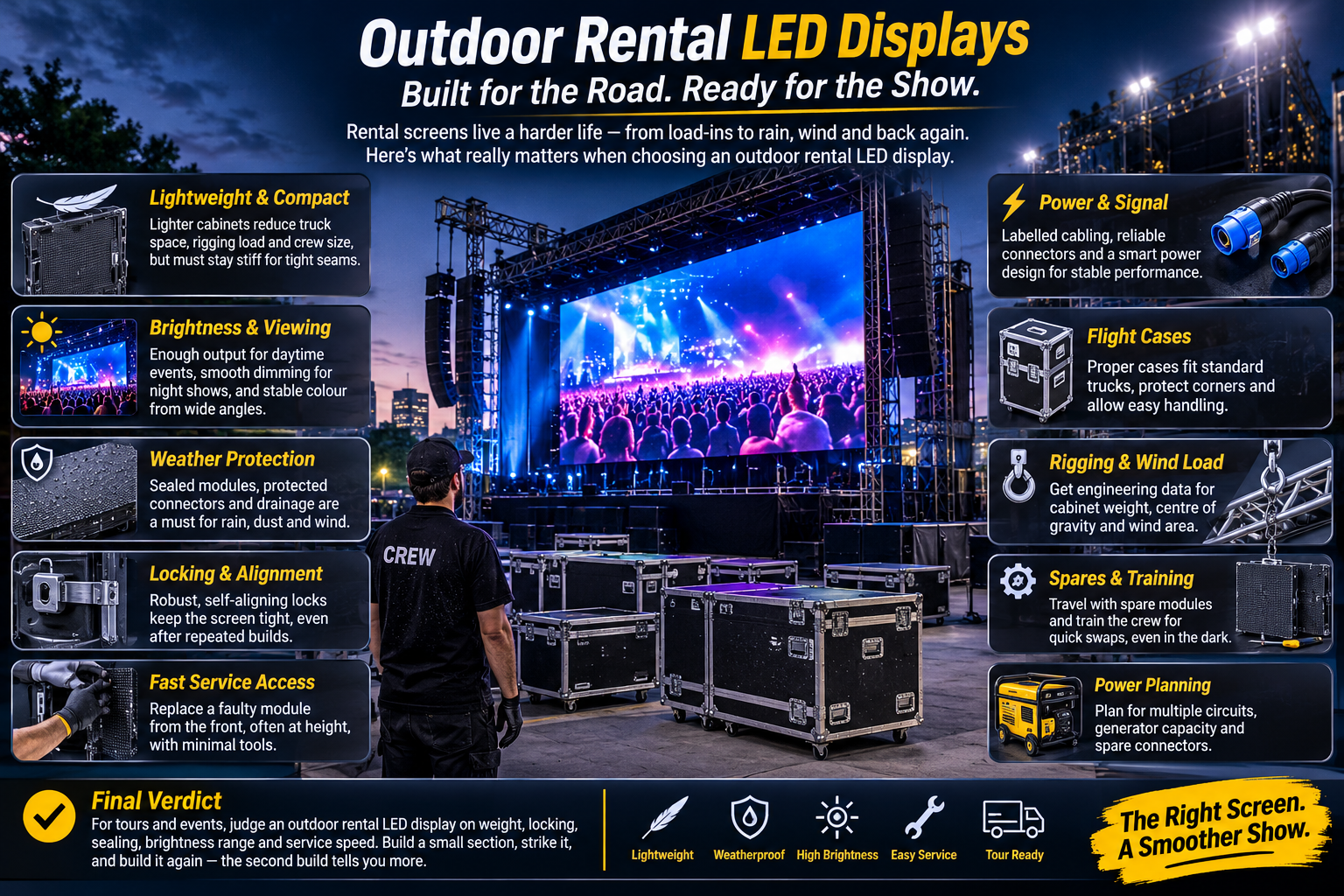
Rental screens live a harder life than fixed installations. They are loaded, flown, rained on, packed away and loaded again, often within the same week. A specification that looks strong in a catalogue can fail quickly once the screen is on a truck and the schedule is tight.
Weight and cabinet size drive the whole build. Lighter cabinets reduce truck space, rigging load and crew size, but they must still be stiff enough to keep seams tight. Handles, locking points and stackability matter as much as the LED itself. A cabinet that is awkward to handle costs time on every load-in.
Brightness has to work outdoors and on camera. Daytime events need enough output to compete with the sun, while evening shows need smooth dimming. The screen should also hold colour and contrast when the viewing angle changes, because rental audiences are rarely directly in front of the stage.
Weather protection is a rental requirement, not an optional extra. Outdoor events can face rain, dust and wind-blown debris. Cabinets need sealed modules, protected connectors and a drainage path. Covers help, but they cannot compensate for a cabinet that traps water.
Locking and alignment decide the finished look. Repeated assembly wears parts, so the locking system should be robust, self-aligning and easy to inspect. Curved configurations add another variable: the cabinet needs to support the required curve without stressing the frame or opening seams.
Service access should be fast. A failed module during a show needs to be replaced from the front, often at height, with minimal tools. Spare modules, power supplies and receiving cards should travel with the screen, and the flight cases should protect them in transit.
Power and signal distribution are part of the rental package. Cabling should be labelled, connectors should be rated for repeated mating, and the power design should allow sensible splitting across available supplies. A screen that needs a specialist electrician at every site is harder to tour.
Flight cases are part of the screen, not packaging. A touring set should pack into cases that fit standard truck dimensions, protect the corners and allow one person to move a cabinet safely. Labelling each case with its position in the build saves time and reduces damage. Cheap cases cost more over a season than they save on the invoice.
Rigging and wind load need engineering, especially outdoors. The screen may hang from a truss, sit on a ground support tower or be ballasted on a stage roof. The cabinet weight, the centre of gravity and the wind area all feed into the calculation. A rental company should be able to provide the load data before the venue approves the design.
Spares and crew training decide how quickly a show recovers. A small stock of modules, receiving cards and power supplies should travel with the tour, matched to the cabinet batch. Crew should practise a module swap in the dark, because that is often when it is needed. Colour consistency between spare and installed modules should be checked before the first show.
Power distribution is easy to underestimate. The screen may need several circuits, and generator capacity has to allow for start-up current and hot weather. Cabling should be labelled and rated for repeated use, with spare connectors on hand. A power plan that works in the warehouse can still fail on a site with a limited supply.
For tours and event production, an outdoor rental LED display should be judged on weight, locking, sealing, brightness range and service speed. Ask to build a small section, strike it and build it again. The second build tells you more about a rental cabinet than the first.
