

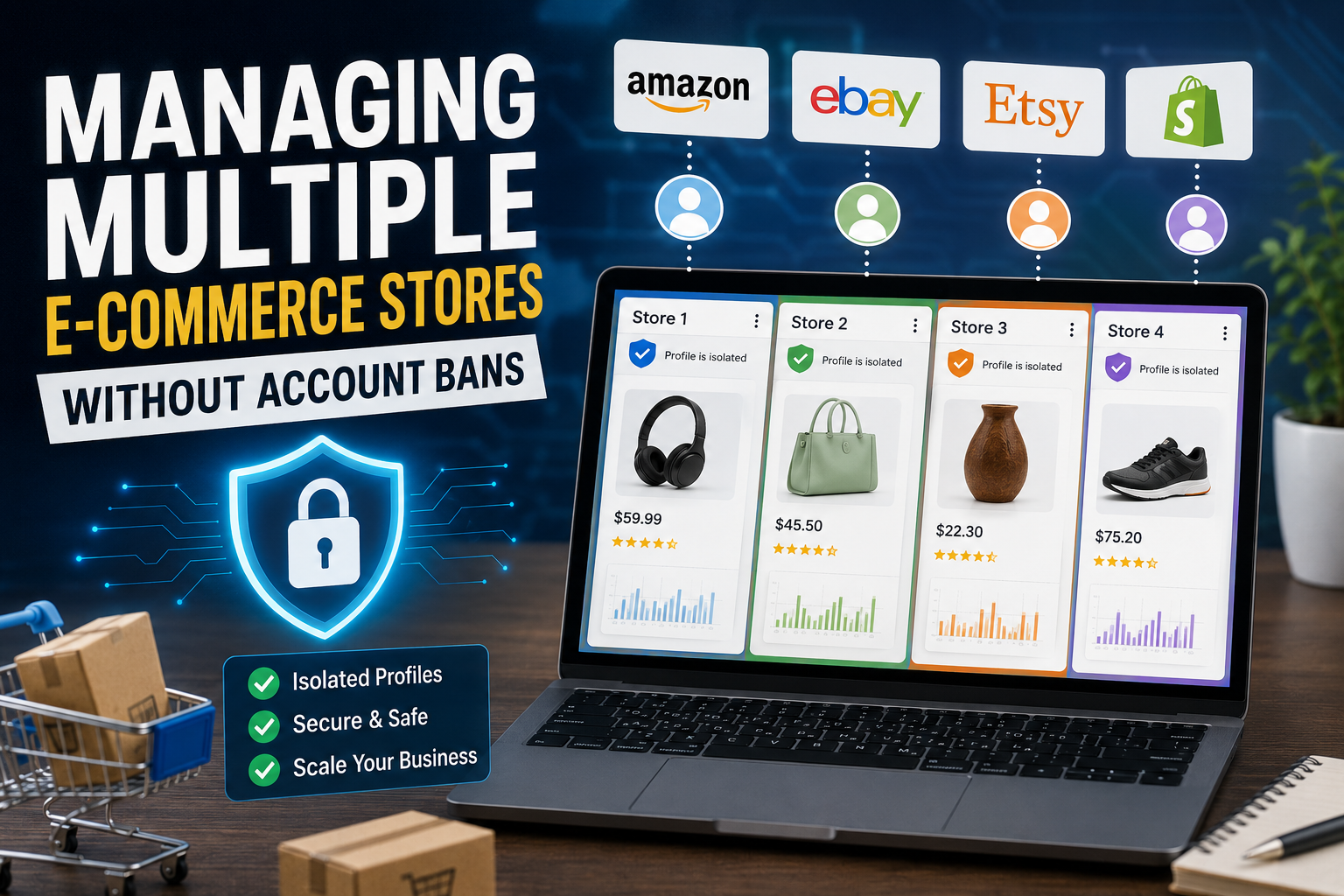
Managing Multiple E-Commerce Stores Without Account Bans
Running several e-commerce stores has become common for dropshippers, online retailers, and brands selling across platforms such as Amazon, eBay, Etsy, and Shopify. Managing multiple storefronts can help businesses separate product lines, target different regions, experiment with pricing, and reduce dependence on a single sales channel. At the same time, marketplaces closely monitor account activity and often impose strict rules around multiple seller accounts.
Most major platforms use automated security systems to evaluate login behavior, devices, networks, and account activity. When several stores repeatedly appear to originate from the same computer or internet connection, those systems may associate the accounts with one another. As a result, a review or restriction placed on one account can sometimes affect other connected stores as well, creating serious operational and financial disruption.
Table of Contents
Why Basic Profile Switching Fails
Some sellers try to separate accounts by using different browser profiles, incognito windows, or by regularly deleting cookies. However, these methods do not fully isolate one browsing environment from another. A standard browser can still expose many of the same device-level characteristics across different sessions.
Marketplaces may analyze technical signals such as Canvas output, WebGL information, installed fonts, browser configuration, audio behavior, screen characteristics, and other system attributes. When multiple merchant accounts consistently share the same underlying device signature, automated security systems may identify them as originating from the same environment.
Changing only the IP address with a conventional VPN may not provide complete separation either, because many device and browser characteristics can remain unchanged. Effective account separation therefore depends on creating independent browsing environments rather than relying only on basic profile switching.
Deploying Isolated Profiles for E-Commerce
A more structured approach is to operate each storefront inside its own isolated browser environment. Using Noid allows merchants to create separate profiles with independent browser storage, cookies, settings, and device parameters.
Each profile can function as a dedicated workspace for a specific store, helping prevent data from one account from overlapping with another. When these profiles are combined with stable and appropriately configured network connections, merchants can maintain more consistent login environments for individual storefronts.
The objective is not simply to change an IP address, but to maintain clear separation between different account environments and reduce accidental cross-account exposure.
Workflow Optimization for Retail Teams
Dedicated multi-profile environments can also improve day-to-day operations for growing e-commerce businesses. Teams can assign specific storefronts to virtual assistants, separate marketplace extensions by account, and maintain organized browser sessions for different stores.
They can also make it easier to preserve cookies, login sessions, research tools, and other account-specific settings without mixing information between storefronts. Secure profile backups can further help teams move work environments between approved devices while maintaining a consistent setup.
For e-commerce businesses operating multiple stores, disciplined account organization and clear environment separation can support more stable workflows, better access control, and more efficient store management.
